ElevenLabs Architect Review 2026: We Built the Same Agent in 90 Seconds
Based on ElevenLabs' post of 20 November 2026 by Vish Kulkarni, plus our own hands-on run of the agent generator on 22 November 2026. Most vendor tutorials show.
Based on ElevenLabs’ post of 20 November 2026 by Vish Kulkarni, plus our own hands-on run of the agent generator on 22 November 2026.
Most vendor tutorials show you the happy path. ElevenLabs published something better on 20 November: a build diary for an outbound appointment reminder agent that documents what broke, in order, with the fixes.
It is the most useful thing they have shipped in weeks, and almost none of the coverage has picked up the part that matters. We also ran the shortcut version ourselves to see how much of that work you can skip. The answer is: less than you would hope.
What Architect is
Architect is the assistant inside ElevenAgents that reads and edits an agent’s configuration, workflow, tools and tests from a chat window. You describe the call you want in plain language, reference tools with an @ mention, and it builds the workflow.
In the article’s build it produced eleven nodes, then added a twelfth — “Verification failed: follow up” — after the first test run exposed a gap. It also scoped each tool to the node that needs it, and removed an agent-level transfer tool that no longer belonged.
We ran the one-click version first
Before reading the whole diary, we gave the agent generator the same brief: call patients, confirm identity by date of birth before disclosing anything, then confirm, reschedule or cancel, with escalation for urgent symptoms and opt-out handling.
It returned a complete, working agent in about 90 seconds. The prompt it wrote is genuinely good. It separates a verification phase from an appointment phase, it refuses to state the clinic name or appointment time before the date of birth checks out, and its voicemail script deliberately omits the patient’s name.
Then we compared it with what the ElevenLabs team actually shipped.

The gap is not cosmetic. Our generated agent had no workflow nodes at all — it is one long prompt. It had no tests. It had two system tools and no integration, so every appointment detail was a template variable with nothing behind it. It even invented a plausible-sounding callback number.
Two of its defaults also run directly against the article’s own advice. The generator picked a fast, cheap model; the team ended on Claude Sonnet 4.6 at temperature zero after the cheaper model failed tests. The generator turned expressive mode on; the team turned it off.
That is the honest summary of the shortcut: it is an excellent way to get a first draft of a prompt, and it is not the thing in the blog post.
The finding that should change how you test
This is the part worth the whole article. The team’s simulation tests mock the tool calls and never reach the server. So when they pushed a real write to the EHR, the request silently dropped two array fields — participant and slot — because they had been added in the tool editor with the wrong element type.
Every test passed. The write was broken. They only caught it by reading the resource back after writing it.
If you build voice agents against any real system, that is the lesson: a green test suite tells you the conversation works, not that the integration does. Read back what you write.
What else broke, in their own words
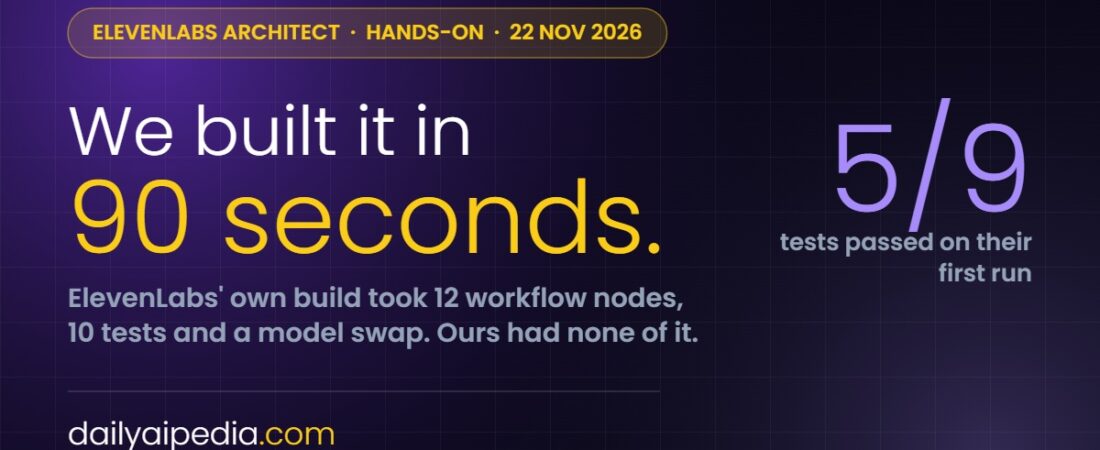
- 5 of 9 tests passed on the first run. The fixes were moving appointment details out of the base prompt into the one node that needs them, rewriting each node prompt to state a single job, and switching models.
- The agent talked over itself. Echo from a speakerphone made it cut itself off, and that node type has no interruption setting. Their advice is to test on a handset.
- It repeated acknowledgements across nodes until a section was added to the base prompt to stop it.
- Architect could not author two fields. The participant and slot arrays for the reschedule and cancel tools had to be added by hand in the tool editor.
- The demo leaves the slot free after a reschedule. A production build has to mark it busy.
What you need before you start
An ElevenLabs account with ElevenAgents, a Twilio number imported into ElevenAgents or a SIP trunk, and a sandbox EHR — the article uses the public HAPI FHIR R4 server, with synthetic data only, because that server is world-readable. For the real-time path you also need a small trigger service to place one call per event.
On concurrency the article is specific: batch calls draw on “a capped share of concurrency (the lower of 50% of the workspace limit or 70% of the agent’s)”, while the real-time path is limited only by what you send. It does not state pricing, credit costs or a required plan.
The compliance notes most tutorials skip
The article is unusually careful here, and these are worth reading before you dial anyone.
An unregistered outbound number can display as “Spam Likely”, so register it for STIR/SHAKEN and set CNAM. The clinic name itself can disclose sensitive information — behavioural health, oncology, HIV — so a neutral parent name may be the safer caller ID. Some states require AI disclosure. And two platform limits matter: batch calls cannot run under Zero Retention Mode, and Architect conversations are not covered by it either, which is why the build uses synthetic data throughout.
The article notes an AI voice counts as an artificial voice under the FCC’s 2024 ruling, and states plainly that it is not legal advice. Neither is this post.
Verdict
Architect is the real thing, and the one-click generator is a genuinely useful starting point — our 90-second agent had a better privacy structure than a lot of production bots. If you want a demo by this afternoon, start there.
But do not confuse it with the build in the article. Twelve nodes, ten tests, tools scoped per node, a model chosen because the cheap one failed, and a live integration bug that no test could catch — that is the actual shape of shipping one of these. The value of ElevenLabs publishing the diary is that you can now budget for it honestly.
If you are evaluating this seriously, the sequence that makes sense is: generate the draft agent, read their diary, then rebuild properly with tests that read back what they write. ElevenAgents has a free tier to try the first step on.
FAQ
What is ElevenLabs Architect?
The assistant inside ElevenAgents that reads and edits an agent’s configuration, workflow, tools and tests from a chat window, rather than you building each node by hand.
Can Architect build a production voice agent on its own?
Not in the article’s experience. It built the workflow, but the team still rewrote node prompts, swapped the model, added a twelfth node after testing, and hand-authored two tool fields Architect could not write.
How many tests passed on the first run?
Five of nine. A tenth test was added later after live calls exposed another problem.
Do ElevenAgents simulation tests hit your real API?
No. They mock the tool calls. In the article every test passed while a live EHR write was silently dropping two fields.
What do I need to build an outbound reminder agent?
An ElevenLabs account with ElevenAgents, a Twilio number imported into ElevenAgents or a SIP trunk, and a sandbox EHR. A trigger service is needed only for the real-time path.
Can batch calling run under Zero Retention Mode?
No. The article states batch calls cannot run under Zero Retention Mode, and that Architect conversations are not covered by it either.
Where to check it yourself
The build diary is at elevenlabs.io/blog/build-an-outbound-reminder-agent-with-architect, published 20 November 2026. Our own generated agent was created on 22 November 2026 using the ElevenAgents agent generator with the brief described above, and deleted afterwards. ElevenAgents is here if you want to run the same test.
Disclosure: DailyAIPedia earns a commission if you subscribe to ElevenLabs through our links. It does not change your price, and it did not change the findings above — the comparison between the generated agent and the published build is in this post precisely because the shortcut is the part a review is expected to flatter.