Gemini 4 Update: What Google Confirmed and How to Test It with Atoms.dev
Updated September 6, 2026. Gemini 4 is officially underway, but it has not launched publicly. Google has confirmed that its most ambitious Gemini pre-training run has started; it.

Updated September 6, 2026. Gemini 4 is officially underway, but it has not launched publicly. Google has confirmed that its most ambitious Gemini pre-training run has started; it has not announced a release date, API model ID, pricing, context window, model card, or public benchmark results.
Start building with Atoms.dev using this invitation and receive 10 credits after signing up and sending your first message.
Gemini 4 release status: confirmed versus unknown
Google first named Gemini 4 in its July 21, 2026 model update. The company said it had begun its most ambitious pre-training run yet and was encouraged by early frontier progress. Sundar Pichai repeated that statement in Alphabet’s Q2 2026 earnings remarks the following day.
| Question | Status as of September 6, 2026 |
|---|---|
| Has Google named Gemini 4? | Yes |
| Has pre-training started? | Yes, according to Google |
| Is Gemini 4 publicly released? | No public release announced |
| API model ID, pricing, or context window? | Not announced |
| Official model card or public benchmarks? | Not published |
| Available inside Atoms.dev? | Not confirmed; check the live model selector |
Why the distinction matters
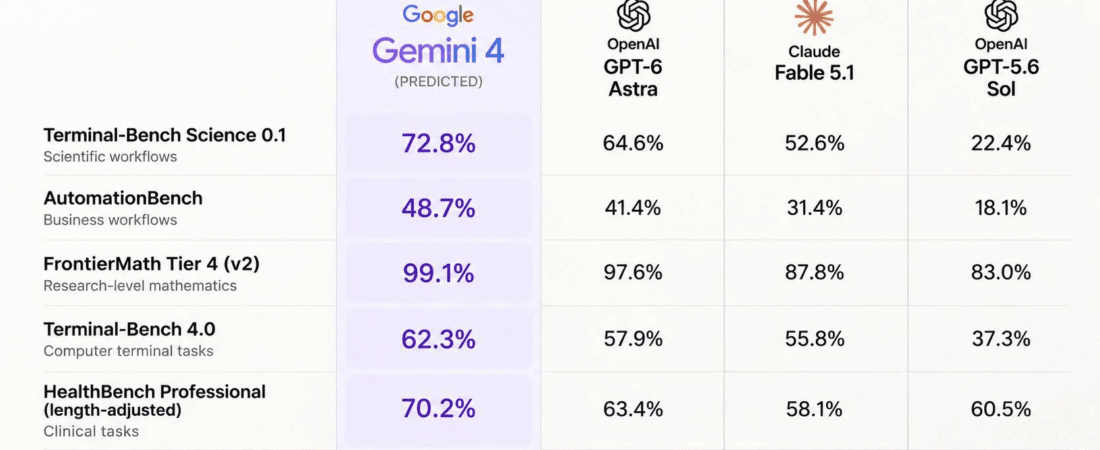
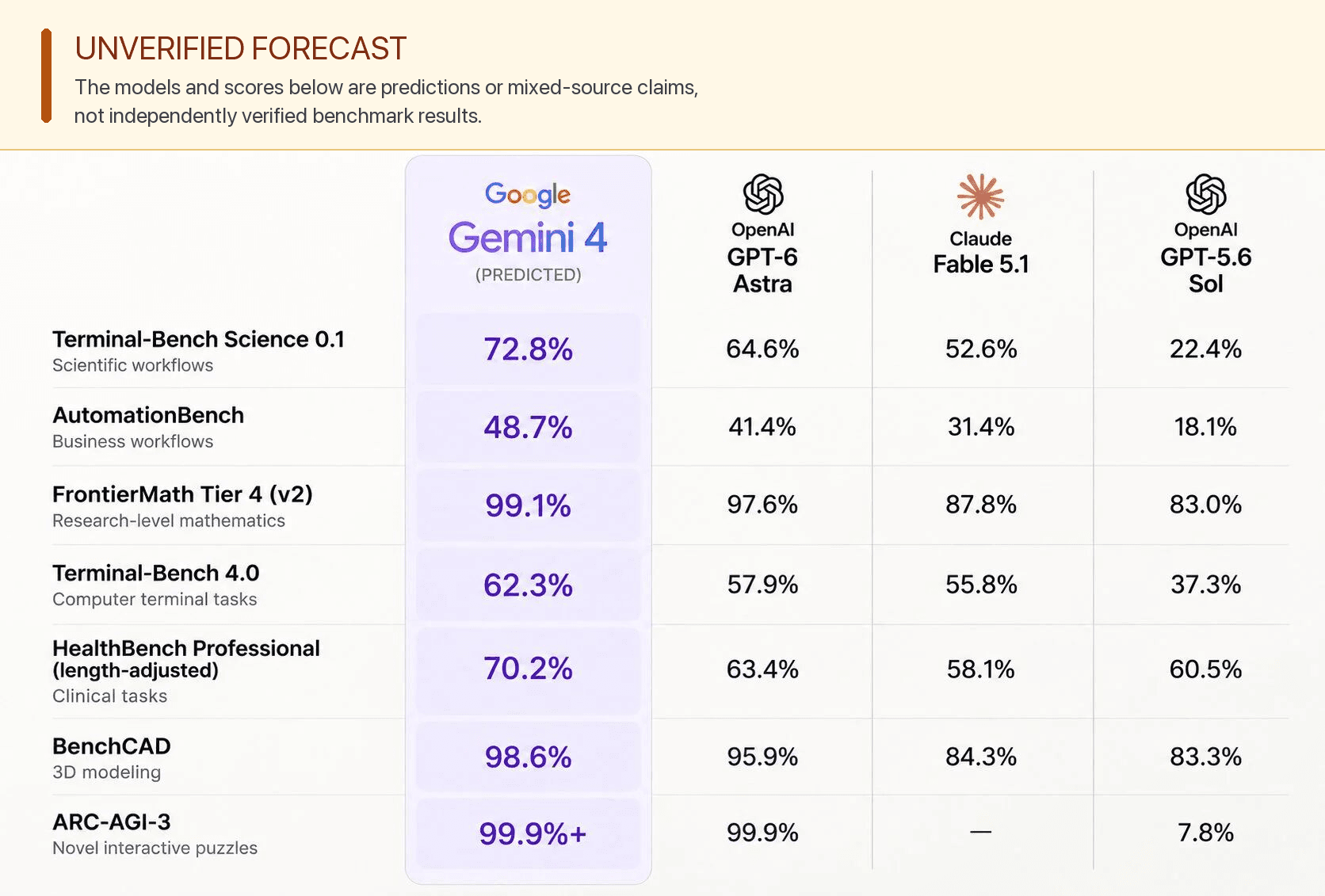
A named training run is not the same as a product release. It does not establish that Gemini 4 is ready, commercially available, accessible through an API, or selectable in Atoms.dev. Treating forecast graphics as benchmark results would be misleading because no official Gemini 4 scores or reproducible test setup have been published.
What teams should prepare to test
The Atoms.dev analysis turns speculation into a useful evaluation plan. Instead of asking whether a future model sounds impressive, teams can design repeatable jobs with outputs that can be inspected and compared.
1. Software engineering and AI coding
Use tasks such as repository exploration, cross-file bug fixes, API integrations, test writing, and feature implementation. Measure acceptance-criteria completion, test pass rate, unwanted edits, retries, tool calls, human corrections, total cost, and elapsed time.
2. Business workflow automation
Test practical interfaces and operational flows: CRM updates, reporting dashboards, approval routing, inbox triage, knowledge portals, lead-generation pages, and ecommerce prototypes. A working interface is only the beginning; identity, payments, data writes, compliance, and failure recovery must also be tested.
3. Research and knowledge work
Evaluate literature synthesis, document analysis, evidence maps, experiment-planning workspaces, and report generation. Track citation accuracy, unsupported claims, tool failures, provenance, and whether another person can reproduce the result.
4. Multimodal, design, and 3D workflows
Potential tests include screenshot-to-interface conversion, document extraction, interactive explainers, product configurators, CAD instruction plans, and visual QA. Judge editable output, constraint violations, tool-call correctness, and the number of manual repairs.
How Atoms.dev fits into the workflow
Atoms.dev uses a multi-agent product-building process to move from an idea or product brief to a reviewable website or application. Different agents can contribute planning, research, design, implementation, testing, and repair. That makes it useful for preparing real evaluation tasks today using models that are currently available.
The sensible approach is to create a small, representative project now, document the prompt and acceptance criteria, and keep the test environment stable. If Gemini 4 later becomes selectable, rerun the same task under the same conditions and compare finished results rather than marketing claims.
A fair Gemini 4 evaluation checklist
- Choose a small set of real jobs: one coding task, one tool-driven workflow, and one domain-specific task.
- Freeze the prompt, repository, tools, evaluator, timeout, and retry budget.
- Run repeated trials; one successful demo is not a reliability estimate.
- Measure task completion, regressions, invalid tool calls, latency, token use, cost, and human correction.
- Record the exact model ID, settings, date, environment, and missing data with every result.
Should you wait for Gemini 4?
For most product work, no. A future model will not replace a clear brief, reliable integrations, acceptance tests, or human review. Build the smallest useful version with an available model, learn where the workflow fails, and preserve that evaluation harness for a controlled Gemini 4 comparison later.
Build and test an AI product with Atoms.dev
Use your first project to create a repeatable benchmark before Gemini 4 arrives. New users receive 10 credits after signing up and sending the first message.
Sources
Affiliate disclosure: DailyAIPedia may earn a commission if you register through the Atoms.dev invitation link, at no additional cost to you. Availability and credit terms may change. This article distinguishes confirmed information from predictions and does not claim that Gemini 4 is currently available.