ElevenLabs September 2026 Updates: Music v2.5, Call Queueing, Voicemail Detection and Scribe v2 Medical
Disclosure: links to ElevenLabs on this page are referral links. If you sign up through them we may earn a commission, at no extra cost to you. Everything.
Disclosure: links to ElevenLabs on this page are referral links. If you sign up through them we may earn a commission, at no extra cost to you. Everything below comes from ElevenLabs’ own changelog and blog, read on 21 September 2026.
ElevenLabs ships something almost every week, and most of it lands in a developer changelog that few people outside engineering teams read. We went through every entry from 17 August to 14 September 2026, plus the Music v2.5 announcement, and pulled out what actually changes things — sorted by who you are, because a creator and a call-centre team care about completely different releases.
The short answer
Creators and musicians: Music v2.5 is the headline. It is now the default model, lossless downloads are on every plan including Free, and you keep the rights to what you make even if you cancel.
Teams running phone agents: call queueing, voicemail detection and keypad input close three gaps that made ElevenAgents awkward for real call-centre work.
Developers: the CLI can now speak text with one command and defaults to Eleven v3, and the MCP server has moved to a hosted endpoint.
Healthcare: Scribe v2 Medical is generally available at the same price as standard Scribe v2.
Every notable ElevenLabs change, 17 August – 14 September 2026
| Date | What shipped | Who it is for |
|---|---|---|
| 17 Aug | Asynchronous Flows APIs for video, image and speech generation in ElevenCreative; reusable media asset APIs | Developers building creative pipelines |
| 22 Aug | Local MCP server deprecated; a hosted version now runs at api.elevenlabs.io/v1/mcp | Anyone using ElevenLabs from an AI assistant |
| 31 Aug | Phone keypad (DTMF) input for agents, with digit timeouts, # terminators and transcript redaction; waveform data for generated music | Voice-agent teams; music app developers |
| 7 Sep | Twilio answering machine detection; workspace-wide triage tickets; conversation search by variables; CLI elevenlabs say with Eleven v3 as default | Outbound calling teams; developers |
| 11 Sep | Music v2.5 becomes the default music model; Scribe v2 Medical generally available | Creators; healthcare |
| 14 Sep | Call queueing with hold audio; Music v2.5 in the API; Gemini 3.8 Flash available as an agent LLM | Voice-agent teams; developers |
Music v2.5: the release most people will notice
ElevenLabs released Music v2.5 on 11 September and made it the default for prompted and reference-based generation. The company says songs come out “more layered and complex” with more natural-sounding instruments, with the biggest gains in vocal-led and acoustic-heavy genres: R&B, soul, hip hop, rock, metal, orchestral and cinematic. Its evidence is a blind comparison across nearly 48,000 pairs of tracks made from identical prompts, in which v2.5 was preferred most of the time. That is ElevenLabs’ own test, so treat it as a claim rather than an independent result.
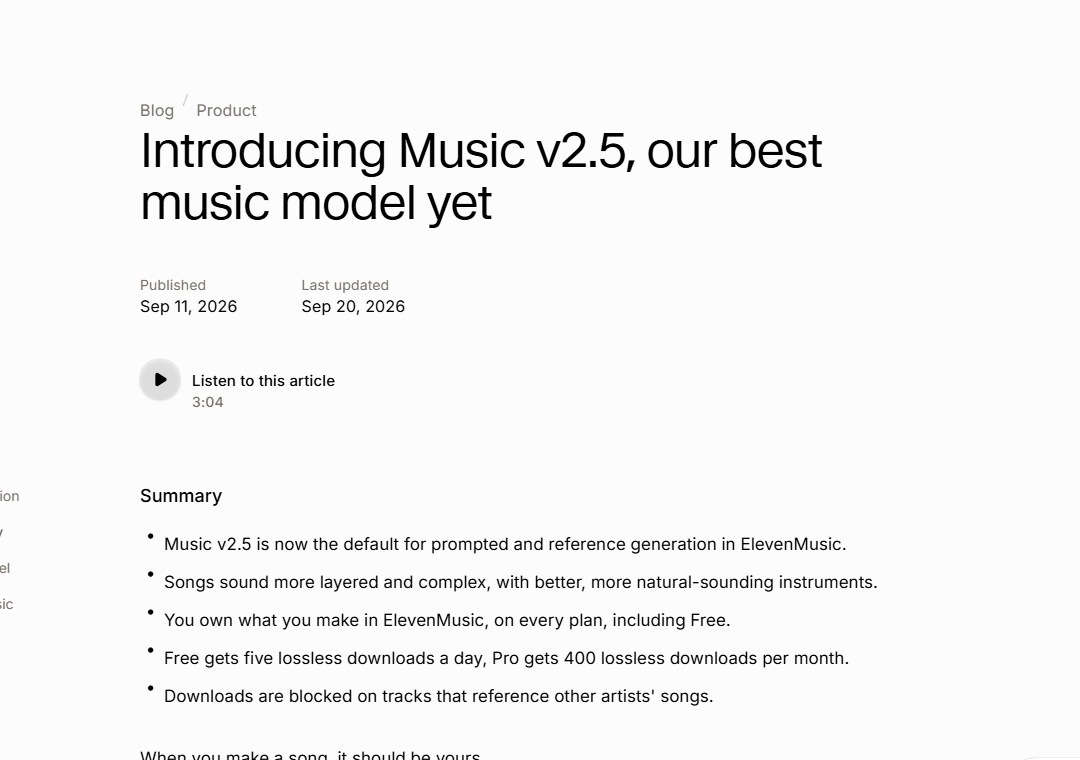
The licensing terms matter as much as the model:
- Lossless downloads on every plan. Free users get five a day; Pro gets 400 a month.
- You own what you make, on every plan including Free, and commercial use is allowed with an ElevenMusic credit.
- Rights survive cancellation. ElevenLabs says usage rights granted at creation persist if you downgrade or cancel, and future policy changes apply only to new tracks.
- Downloads are blocked for tracks that reference other artists’ songs.
- Music v2 stays available. If you preferred the old sound, you can keep using it.
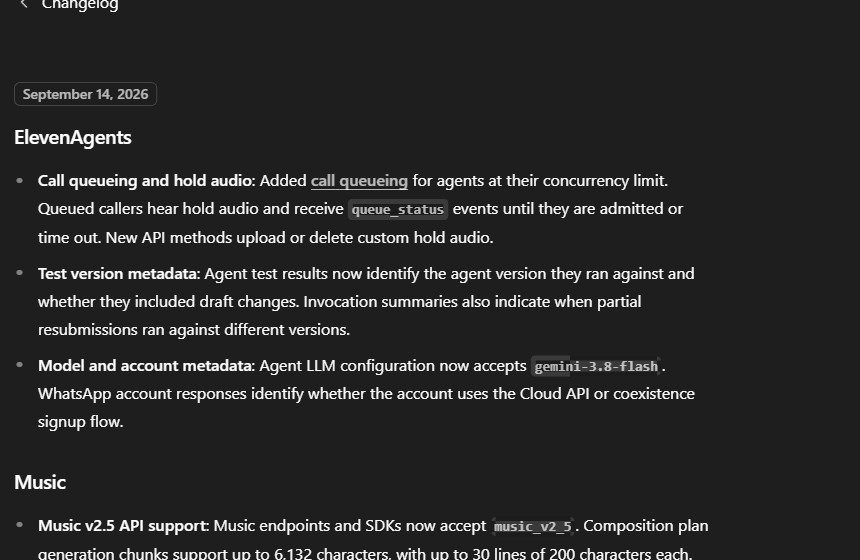
For the API, the model ID is music_v2_5, and composition plans can now run to 6,132 characters — up to 30 lines of 200 characters each — which gives developers noticeably more room to structure a song section by section. If you are comparing AI music tools, our Soundverse AI review covers the main alternative built specifically for musicians.
Call queueing: agents no longer drop callers at capacity
Until 14 September, a caller who reached an ElevenLabs agent that was already at its concurrency limit had nowhere to go. Now they can be queued. They hear hold audio — you can upload your own as MP3 or WAV, up to 40MB and 180 seconds — and the system sends queue_status events so your app knows what is happening. The maximum wait is configurable from 1 second to 30 minutes, with a three-minute default.
The detail that makes this practical: time spent waiting in the queue is not billed. For a small team that sets a low concurrency limit to control cost, that turns peak-hour overflow from lost calls into a short wait.
Voicemail detection and keypad input: built for outbound calls
Two smaller releases make ElevenAgents much more usable for outbound campaigns. Answering machine detection for Twilio calls, added 7 September, comes in two modes: one returns a verdict immediately, the other waits for the voicemail greeting to finish so the agent can leave a message at the right moment. Results arrive through a webhook. On 31 August, agents also gained keypad (DTMF) input, so callers can enter account numbers or menu choices, with configurable timeouts, a # terminator, and the option to redact sensitive digits from transcripts.
Add workspace-wide triage tickets and search by conversation variables, both from 7 September, and the pattern is clear: ElevenLabs is building the plumbing call centres expect. We covered the earlier half of that push in ElevenAgents goes multimodal.
Scribe v2 Medical
ElevenLabs’ speech-to-text model now has a clinical variant, generally available since 11 September. It is priced the same as standard Scribe v2 and keeps the same features — keyterm prompting, entity detection, speaker diarization and a no-verbatim mode — and developers select it with the model ID scribe_v2_medical. The changelog does not list compliance certifications, supported languages or accuracy figures, so anyone evaluating it for patient data should get those from ElevenLabs directly before using it.
For developers: the smaller changes worth knowing
- CLI v1.2.0 adds
elevenlabs sayfor one-line text to speech, witheleven_v3as the default model; v1.3.0 adds optional intent metadata and feedback reporting. - MCP server: the local server is deprecated in favour of the hosted endpoint, so assistant integrations need their config updated.
- ElevenCreative Flows now run asynchronously across video, image and speech, with reusable workspace media assets.
- JavaScript and Python SDKs reached v2.68.0 with hold-audio and music-composition support.
What did not change: pricing
None of these releases touched ElevenLabs’ subscription prices. Starter is still $6 a month and Creator $22 as of our last check, and the full plan-by-plan breakdown — including how little dubbing is actually included — is in our AI Voice Pricing Tracker, re-verified on the first of every month.
The verdict
For most readers, this month comes down to Music v2.5 and its licensing: better-sounding songs, lossless downloads even on the free plan, and ownership that survives cancellation. For businesses, the more important work is less visible. Queueing, voicemail detection and keypad input are unglamorous, but they are exactly the features that decide whether a voice agent can replace a phone line or only demo well.
You can try the new music model and the agent platform with a free ElevenLabs account. For how ElevenLabs compares overall, see our ElevenLabs review and the ElevenLabs vs Murf comparison.
Sources: ElevenLabs changelog entries for 17, 22 and 31 August and 7, 11 and 14 September 2026, and the ElevenLabs blog post announcing Music v2.5 (11 September 2026), all read on 21 September 2026.
Related guides
- ElevenLabs Recent Updates 2026: CLI v1, ElevenAgents Procedures, Dubbing v2, Music v2, and Ads Engine
- ElevenLabs in 2026: What Changed in Voice AI, Agents, and Creative Tools
- ElevenAgents Goes Multimodal: Images, PDFs, Procedures, and Speech Engine Explained
- Murf AI Pricing 2026: Studio, API and Dubbing Costs, Worked Out Per Minute