Solo Fund AI Review 2026: An AI Decision Journal for Solo Investors, Not a Tip Bot
How this review came about: Solo Fund AI submitted its tool to DailyAIPedia for editorial consideration. This is not a sponsored placement, we were not paid, and we.

How this review came about: Solo Fund AI submitted its tool to DailyAIPedia for editorial consideration. This is not a sponsored placement, we were not paid, and we hold no affiliate link for it — the outbound links below are unpaid and marked nofollow. It is also not a hands-on test: we read features, limits and prices off Solo Fund AI’s own homepage, pricing page, credits page and sample report on 24 October 2026. Prices are in US dollars. Nothing here is investment advice.
Most AI tools for investors try to answer “should I buy this?”. Solo Fund AI deliberately doesn’t. It calls itself a decision desk: you bring an idea, such as adding to a position, and it forces the idea through the same five steps every time, writing down your assumptions, what you don’t know, and the condition under which you would get out. The pitch is that emotion skips steps, and a fixed process doesn’t.
The short version
What it is: an AI-structured decision journal for solo investors, with five fixed stations per idea.
Price: 50 free credits (about six runs), then $19, $49 or $99 a month, or one-off packs from $9.
Best feature: it records data gaps and a pre-committed exit, and defaults to “no further action” when your notes are incomplete.
The catch: it is not advice, has no broker connection, and its quality depends on what you paste in.
How the five-station desk works
| Station | What it records |
|---|---|
| 01 Executive Summary | The problem and your rules, for example a single-stock cap, a maximum drawdown and a review date |
| 02 Authorization | One narrow task, such as how much room is left under your position cap |
| 03 Directive | Working notes, exit criteria (a “kill condition”), a size note, stated assumptions and explicit data gaps |
| 04 Request | An automatic, conservative outcome; incomplete notes produce “no further action recorded” |
| 05 Workflow | Owner, next review date and status, so the entry can be revisited |
Solo Fund AI’s sample report shows a question like “Should I add to NVDA? Weight 4%, book $150k” producing a structured log that ends with no action because the thesis is not written down. That conservative default is the most distinctive design choice here: a general chatbot tends to produce a confident answer whatever you give it.
Pricing
| Option | Price | Credits | ≈ Full runs | Extras |
|---|---|---|---|---|
| Free | $0 | 50 on sign-up | ~6 | No card required |
| Starter | $19/mo | 300/mo | ~37 | Chat access |
| Pro (most popular) | $49/mo | 800/mo | ~100 | Risk rule presets, CSV export, print/PDF decision log |
| Fund Desk | $99/mo | 2,000/mo | ~250 | Export, presets, priority support |
| Credit packs | $9 / $24 / $59 / $129 | 150 / 500 / 3,000 / 10,000 | ~18 / ~62 / ~375 / ~1,250 | One-off, via Stripe or PayPal |
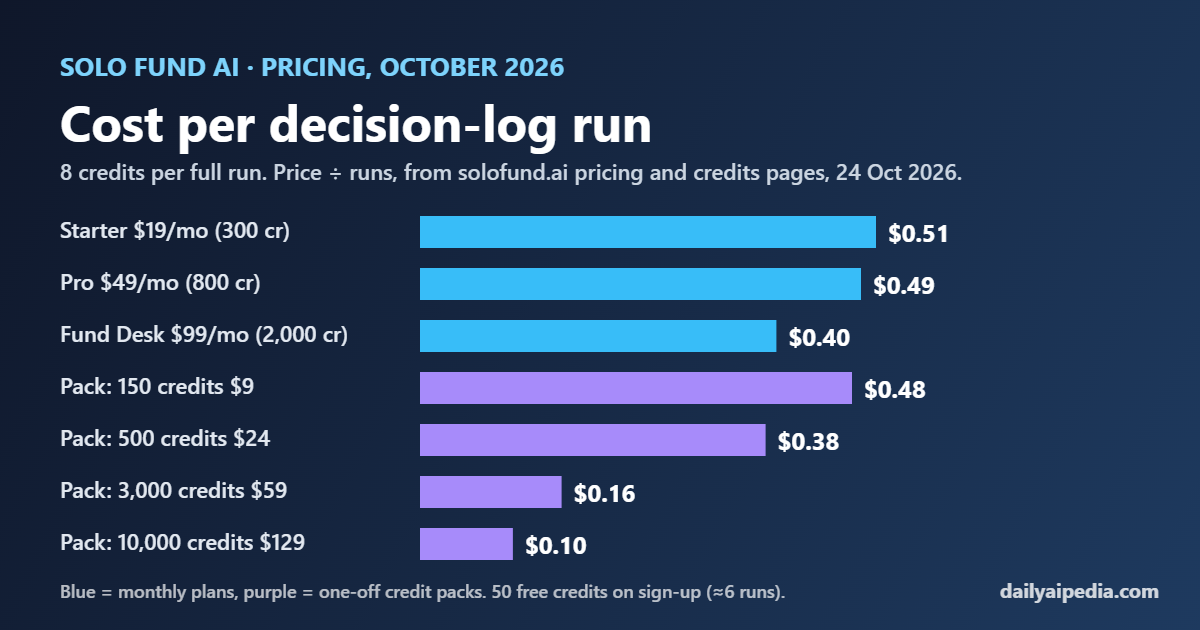
The large packs are dramatically cheaper per run than the subscriptions: about $0.10 per run on the $129 pack against $0.40–$0.51 on monthly plans. The subscriptions’ real value is the Pro features: risk presets applied to every run and exportable history, which turn the desk into a journal you can review later.
Privacy and what it does not do
Solo Fund AI says your prompts and holdings are not used to train public models, that it never asks for broker passwords, and that you can clear your chat history at any time. It does not execute trades or hold assets. Its notices reference Hong Kong law and stress that it does not provide regulated investment advice there or elsewhere, and that access may be restricted where local law requires licensing.
Who should try it
- Individual investors who already keep (or want to keep) a trading journal and want structure without a spreadsheet.
- People who know they make impulsive decisions and want a process that slows them down.
- Anyone who wants “what we don’t know” written down every time, instead of a chatbot that fills gaps silently.
It is a weaker fit if you want stock picks, live portfolio tracking or broker integration; it offers none of those by design.
What we could not verify
Open questions, stated plainly
- Output quality. We have not run our own ideas through the desk, so we can’t judge how useful the notes are beyond the published sample.
- Privacy claims. The no-training and data-handling statements are the company’s own; we have not audited them.
- A small inconsistency. The credits page says “about 18 runs per 50-credit pack”; at 8 credits per run, 18 runs matches the 150-credit pack, not a 50-credit one.
- Market data source. The sample mentions “desk-fetched” prices, but the site does not name its data provider.
Verdict
Solo Fund AI is an unusually honest take on AI for investors: instead of predictions, it sells discipline. The five-station log, explicit data gaps and pre-committed exit criteria are exactly what most self-directed investors skip, and the conservative “no further action” default is a good guardrail. Start with the 50 free credits to see whether the format suits you; if it does, Pro’s presets and export are the features that make it a real journal. Try Solo Fund AI free.
Features, prices and policies were read off Solo Fund AI’s website, pricing page and credits page on 24 October 2026. Cost per run is our own arithmetic. We have no affiliate relationship with Solo Fund AI. This review is educational and is not investment advice. If prices change materially, this post gets a dated update box rather than a silent edit.
Frequently asked questions
What is Solo Fund AI?
Solo Fund AI is an educational decision-log tool for individual investors. You enter an investment idea, and it walks the idea through five fixed stations (Executive Summary, Authorization, Directive, Request and Workflow), recording assumptions, data gaps and exit criteria. It says clearly that it is not investment advice.
Is Solo Fund AI free?
New accounts get 50 free credits, and each full decision-log run costs 8 credits, so the free allowance covers about six runs. No card is needed to start.
How much does Solo Fund AI cost?
Monthly plans are Starter at $19 (300 credits), Pro at $49 (800 credits, risk presets, CSV and PDF export) and Fund Desk at $99 (2,000 credits). One-off credit packs run from $9 for 150 credits to $129 for 10,000 credits.
Does Solo Fund AI connect to my broker?
No. Solo Fund AI says it does not place trades, hold assets or ask for broker logins. You paste only the holdings you choose for a run.
Does Solo Fund AI give buy or sell recommendations?
No. Its outputs are structured notes for your own records. When notes are incomplete, its automatic Request step records “no further action” rather than suggesting a trade.