Close CRM Review 2026: Chloe AI, Real Pricing and the Costs That Are Not on the Price Page
Disclosure: the Close links in this article are referral links. If you start a trial through one, DailyAIPedia may earn a commission at no extra cost to you..
Disclosure: the Close links in this article are referral links. If you start a trial through one, DailyAIPedia may earn a commission at no extra cost to you. It changes nothing about what is written below — every price and limitation here was read directly off Close’s own pages on 17 September 2026 and is quoted rather than paraphrased where it matters.
Close is a sales CRM built around the phone. Not a database with a dialer bolted on — a calling, emailing and texting tool that happens to store your pipeline. In 2026 it added Chloe, an AI sales agent that places outbound calls, qualifies leads, books meetings and writes the CRM record afterwards.
The marketing is loud. The pricing page, read carefully, is more interesting than the marketing — and it contains two things that will change which plan you buy. This review covers what Close actually charges, what Chloe actually does, and the two traps in the plan structure.
The short verdict
| Best for | Teams whose revenue comes from outbound and inbound phone calls |
| Real entry point | Growth, $99–$109/user/month — not the $9 or $35 plans |
| Biggest strength | Chloe is inside the CRM, not integrated with it |
| Biggest limitation | Chloe speaks English only |
| Skip it if | Your sales process is email-only, or your market is not English-speaking |
Close CRM pricing in 2026: every plan, both billing cycles
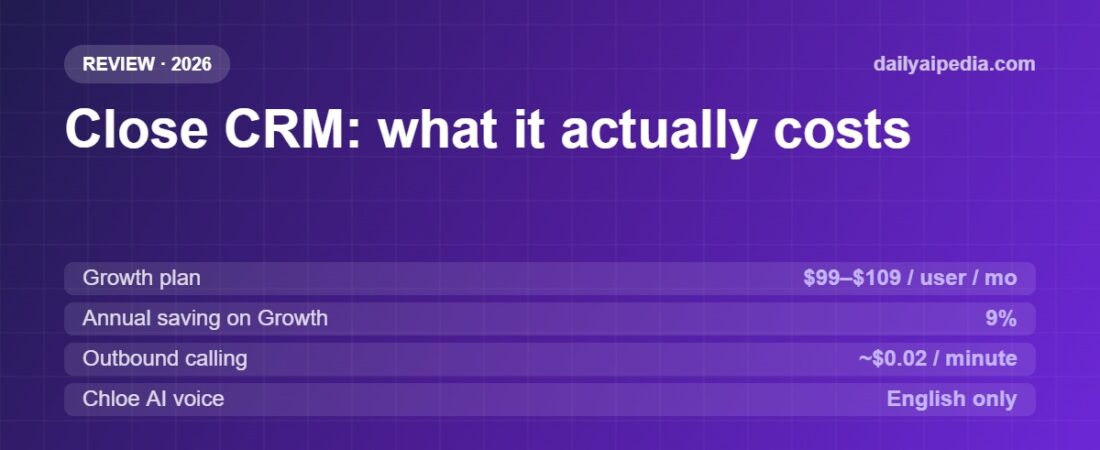
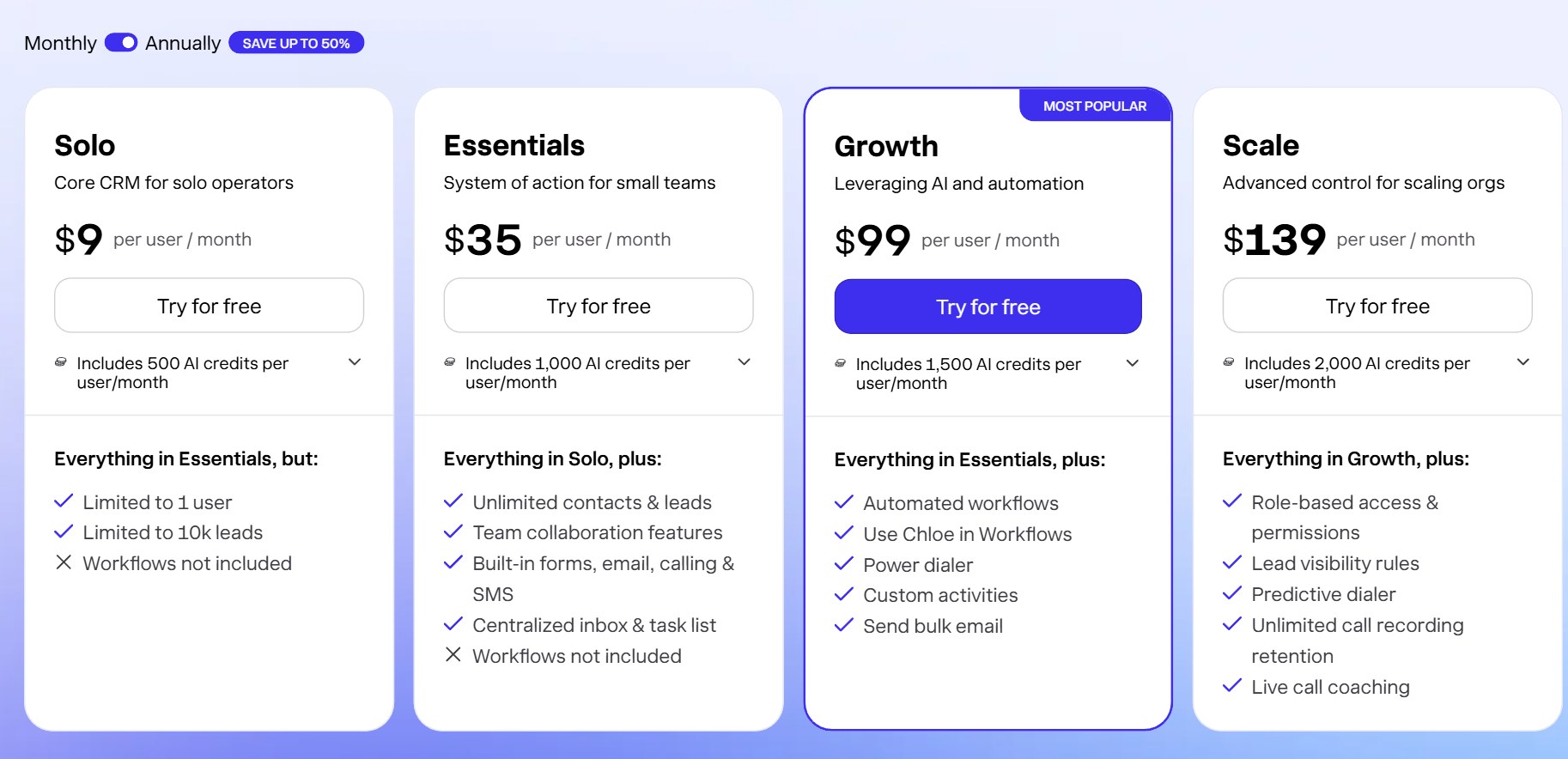
Close sells four plans, priced per user per month. The pricing page opens on annual billing with a “save up to 50%” badge attached. Here is what both cycles actually cost, side by side:
| Plan | Monthly | Annual | You save | AI credits |
|---|---|---|---|---|
| Solo | $19 | $9 | 53% | 500 |
| Essentials | $49 | $35 | 29% | 1,000 |
| Growth most popular | $109 | $99 | 9% | 1,500 |
| Scale | $149 | $139 | 7% | 2,000 |
Per user, per month. AI credits are per user, per month, and do not roll over. Read from close.com/pricing on 17 September 2026.
Trap one: the annual discount shrinks as the plan gets more expensive
“Save up to 50%” is technically true and practically misleading. The 53% saving exists on Solo, the $19 plan aimed at one person. On Growth — the plan Close marks as most popular and the one most teams end up on — committing to a year saves 9%. On Scale it is 7%.
That matters because of what you give up for it. Close’s own FAQ states the terms plainly: monthly subscriptions “can be upgraded, downgraded, or canceled anytime,” while on annual plans “downgrades or cancellations take effect at the end of the billing term.”
So on Growth you are trading a full year of flexibility for roughly $10 per user per month. For a five-person team that is $600 a year against being locked in through a bad quarter, a failed hire, or a change of strategy. If you are certain about Close, take it. If you are still evaluating, the monthly price is close enough that there is no reason to commit.
Trap two: automation does not exist below $99
This is the one that catches people. Close’s plan comparison lists “Workflows not included” as an explicit exclusion on both Solo and Essentials. Automated workflows — and “Use Chloe in Workflows” — appear for the first time on Growth.
What this means in practice
If you buy Essentials at $35–$49 expecting sequences, automated follow-up or Chloe working your pipeline unattended, you will not get it. The jump from Essentials to Growth is roughly 3× the price, and it is the jump that buys the entire automation layer. Budget for Growth from the start, or accept that you are buying a manual CRM.
What Essentials does give you over Solo is real, just not automated: unlimited contacts and leads (Solo caps at 10,000 and one user), team collaboration, built-in forms, a centralised inbox and a shared task list.
Scale adds operational control rather than capability — role-based permissions, lead visibility rules, a predictive dialer, unlimited call recording retention and live call coaching. Close’s own guidance is worth repeating: “If your reps spend most of their day prospecting and calling, Scale is usually the right fit.”
The costs that are not in the per-seat price
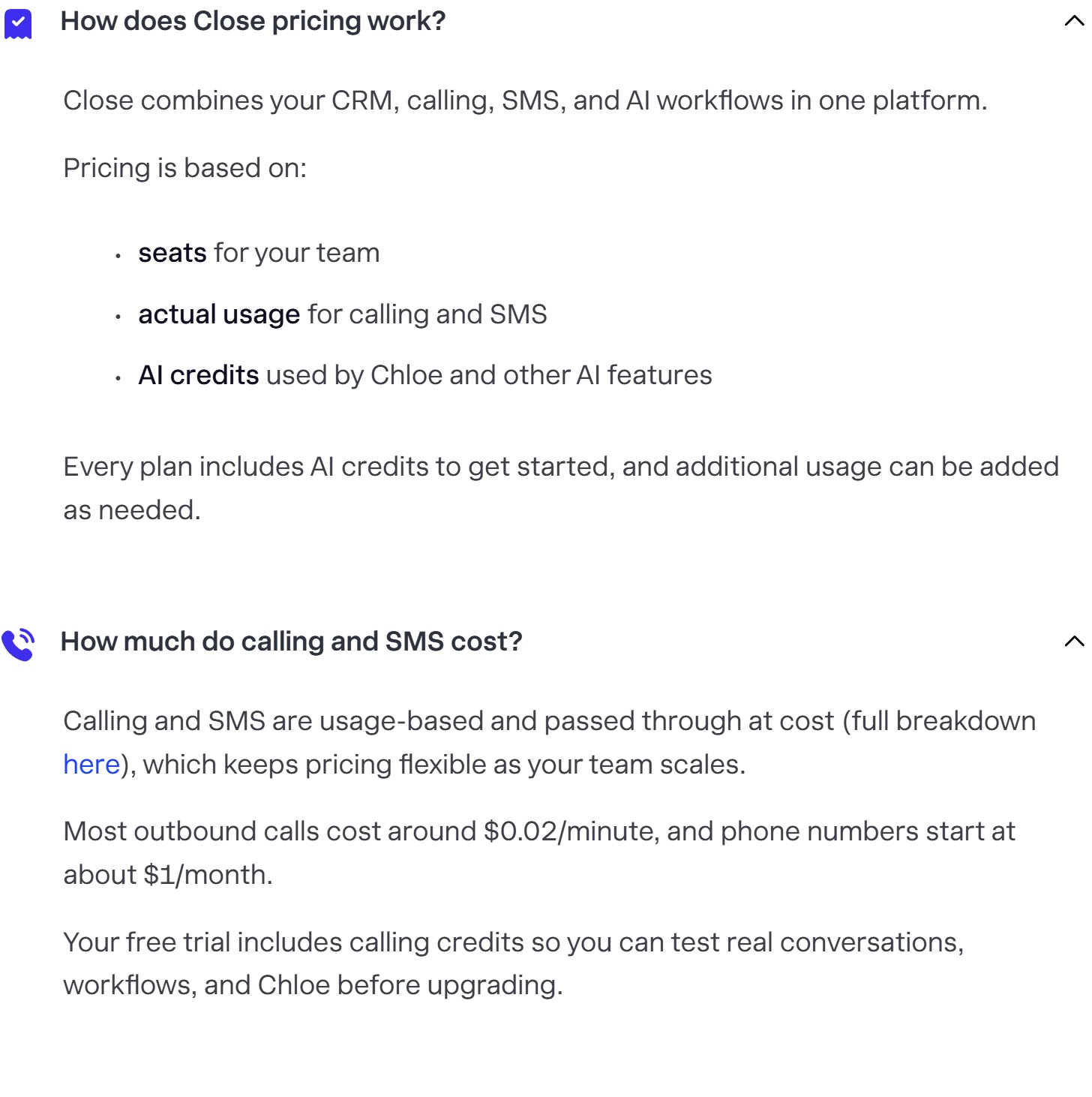
Close is unusually candid about this, which is to its credit — but you have to open an FAQ accordion to find it. The pricing model has three components, not one:
- Seats for your team — the headline number above.
- Actual usage for calling and SMS.
- AI credits used by Chloe and the other AI features.
The published usage rates: outbound calls cost around $0.02 per minute, and phone numbers start at about $1 per month. Close says calling and SMS are “passed through at cost.” A free trial includes $5 of calling and enrichment credits.
Those rates are genuinely cheap — this is not a criticism of the price, it is a correction to the budget. Here is what a realistic five-rep team on Growth annual actually pays in a month:
Worked example: 5 reps, Growth annual
| 5 seats × $99 | $495 |
| 5 phone lines × $1 | $5 |
| Calling: 2 h talk time/rep/day × 22 days × $0.02/min | $264 |
| AI credit overage | not published |
| Monthly total | ≈ $764 — about $153 per rep |
That is roughly 54% above the sticker price, driven almost entirely by talk time. Change the assumption and the number moves: a team doing one hour of connected talk time a day lands near $126 per rep; a hard-dialing team at four hours a day lands near $206. The lesson is not that Close is expensive. It is that with a usage-priced dialer, your bill is a function of how hard your team works the phone, and no pricing page can tell you that number. Estimate your own talk minutes before you compare Close to a flat-rate CRM.
The AI credits are the genuinely opaque part
Every plan includes a monthly credit allowance — 500 to 2,000 per user. On Growth the detail reads: a shared pool of 1,500 credits per user, capped at 15,000 per month, refreshing monthly with no rollover, with additional credits available to buy.
That cap is worth noticing. Above ten users on Growth, the pool stops growing even though your seat bill keeps rising.
What Close does not publish anywhere on the pricing page is what a credit buys. The tooltip says only that credits are “how many credits your Close plan already includes monthly.” There is no rate card for a minute of Chloe voice, an enrichment lookup or a generated summary. Until that exists, the only way to size your AI spend is to run the trial and watch the meter — which is exactly what the trial’s included credits are for, and exactly why you should use them deliberately rather than casually.
Chloe: what the AI agent actually does
Chloe is the reason to look at Close in 2026 rather than any other phone-first CRM. The pitch is that she is not an integration: “Chloe operates entirely within Close. Your data never leaves the platform to a third-party AI vendor. Every action Chloe takes is logged, reviewable, and editable by your team.”
The verified feature list, by plan:
| Capability | Solo | Essentials | Growth | Scale |
|---|---|---|---|---|
| Chloe batch calling | Yes | Yes | Yes | Yes |
| Chat (beta) | Yes | Yes | Yes | Yes |
| Lead enrichment | Yes | Yes | Yes | Yes |
| Use Chloe in Workflows | No | No | Yes | Yes |
| Auto updates to CRM records | No | No | Yes | Yes |
| Restrict user access to Chloe | No | No | No | Yes |
| Call recording retention | 30 days | 30 days | 90 days | Unlimited |
Note the retention row if you are in a regulated industry or ever need to review an old call: 30 days is short, and unlimited retention sits behind the $139–$149 plan.
The disclosure policy is the best thing in the product
AI voice agents live or die on whether the person on the other end knows what they are talking to. Close’s answer is unambiguous, and we are quoting it in full because the wording matters:
“Yes — always. Chloe is required to disclose that she is an AI and that the call is being recorded at the start of every conversation. This cannot be overridden.”
“This cannot be overridden” is the part that counts. A disclosure you can switch off is a marketing line. A disclosure the buyer cannot remove is a product decision, and it is the right one — both ethically and because it keeps you on the correct side of consent and recording law in most jurisdictions. If you are comparing AI calling tools, make this your first question about every one of them.
Where Chloe falls short
- English only. Close’s FAQ: “Chloe is currently available in English. Additional languages are on the roadmap.” If you sell in Hindi, Spanish, Arabic or anything else, the voice agent — the headline feature — is not available to you yet. This single line disqualifies Close for a large share of non-US teams.
- Workflows gate the unattended mode. Below Growth, Chloe is a helper you invoke, not an agent working your pipeline on its own.
- Setup is conversational, not instant. Close says notetaking, pipeline suggestions, enrichment and chat work out of the box, but Chloe Voice takes “under an hour” for most teams — you give her a script, qualification criteria and knowledge sources.
- The credit meter is unpriced. Covered above, and it is the single biggest unknown in the total cost.
Who each plan is genuinely for
| Solo — $9/$19 | One person, up to 10,000 leads, no automation. A real CRM instead of a spreadsheet, with a dialer. Fine for a founder selling their own product. |
| Essentials — $35/$49 | A small team that wants one shared place for every call, email and deal. Still no workflows. Choose it knowingly, not by accident. |
| Growth — $99/$109 | The first plan where Close is the product it advertises. Workflows, Chloe in workflows, power dialer, bulk email, 90-day recordings. If Chloe is why you are here, this is your floor. |
| Scale — $139/$149 | High-volume phone teams needing permissions, lead visibility rules, predictive dialing, live coaching and unlimited recording retention. |
How to evaluate it without wasting the trial
The trial needs no credit card and includes $5 of calling and enrichment credits, plus a 30-day money-back guarantee if you buy and change your mind. $5 of calling is roughly 250 minutes at the published rate — enough to learn something, not enough to waste. A sensible order:
- Import a real list, not a test list. Chloe’s value comes from context in your pipeline; empty data tests nothing.
- Set Chloe Voice up first, on day one. It is the feature that decides the purchase and the one that takes setup time.
- Let her make twenty real calls and listen to all twenty. Close lets you review recordings and transcripts and leave feedback, which is the only honest way to judge an AI caller.
- Watch the credit meter while you do it, and extrapolate to a full month at your real call volume. This is the number the pricing page cannot give you.
- Then decide monthly or annual. On Growth the annual discount is 9% — small enough that “monthly until we are sure” is a defensible answer.
Try Close: the trial is free and takes no credit card — start it here. That is a referral link, so we may earn a commission if you later subscribe; it costs you nothing extra and does not change the pricing above. If Close is not a fit after reading this, the honest answer is not to start the trial.
The bottom line
Close is the most convincing “AI inside the CRM” story we have reviewed, and the disclosure policy behind Chloe Voice is better than the industry norm. The product is well matched to the team it targets: people who sell by talking to prospects on the phone.
But buy it with your eyes open on three points. Automation starts at $99, not $9. Your real bill is seats plus talk time, and talk time is the bigger variable than most teams expect. And if your market is not English-speaking, the feature you came for does not work yet.
All pricing, plan limits and quoted policy text verified against close.com on 17 September 2026. Vendors change prices; if you spot a discrepancy, tell us and we will re-check.
Related reading on DailyAIPedia
- Typeform Video Questions Review 2026 — the same pattern in a different tool: the feature sits two plans above the one most teams already pay for.
- AI Voice Tool Pricing Tracker — 16 voice tools with prices we re-verify every month, including cost per hour of audio.
- AI Voice Tool Picker — five questions, then a shortlist matched to what you are actually building.
- Fireflies.ai Review 2026 — if it is meeting notes rather than outbound calling you need.
Related guides