Base44 Review 2026: Every Paid Tier Costs the Same Per Credit (Except One)
Pricing read from Base44’s own pricing page and billing documentation on 19 November 2026, with both billing toggles checked. Base44 is a no-code AI app builder. You describe.

Pricing read from Base44’s own pricing page and billing documentation on 19 November 2026, with both billing toggles checked.
Base44 is a no-code AI app builder. You describe what you want in plain language and it produces a working application — interface, backend, database, user accounts, payments — running on production infrastructure rather than a preview sandbox. It sits in the same bracket as Lovable, Replit and Bolt, and competes on how much of the stack it handles without you opening a file.
Most write-ups stop at the feature list. The interesting part of Base44 is how it charges, so that is where this review spends its time.
What Base44 does
You build by chatting. Base44 plans the change, writes it across however many files it needs, and applies it. A visual editor sits alongside for direct edits — dragging elements, changing layouts, retyping text — and those manual edits are free, which matters more than it sounds.
Every plan, including Free, includes authentication, a database, cloud storage, analytics, multi-user editing and the debugging tools. There is no tier where the backend is withheld. What the paid tiers add is credits, integrations, GitHub sync and support.
Base44 pricing
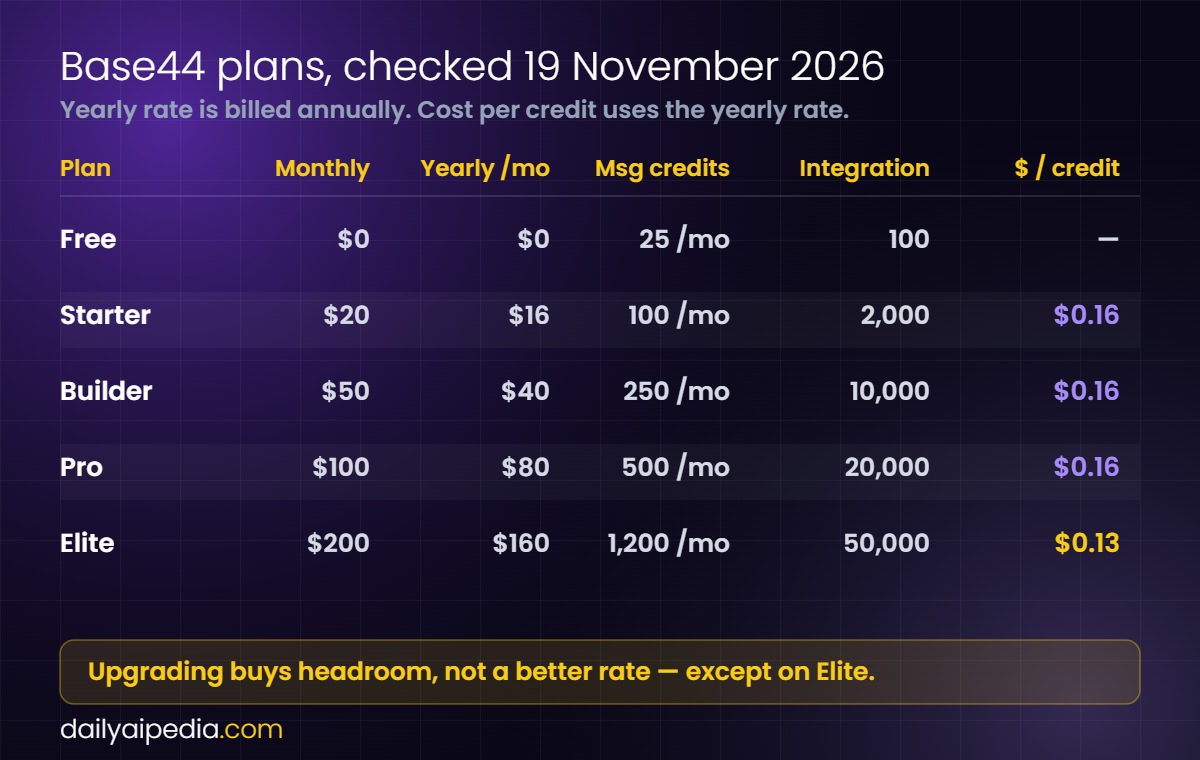
Annual billing takes 20% off every paid tier. It also quietly adds two things monthly plans do not get: a free domain for one year and 25 credits to share with a friend. Those two perks disappear from the feature list when you flip the toggle to monthly. If you were planning to buy a domain anyway, the annual discount is bigger than the 20% on the label.
The number the pricing page does not show
Divide each plan by the credits it includes and the tiers stop looking like a ladder:
- Starter — $192/yr ÷ 1,200 credits = $0.16 per credit
- Builder — $480/yr ÷ 3,000 credits = $0.16 per credit
- Pro — $960/yr ÷ 6,000 credits = $0.16 per credit
- Elite — $1,920/yr ÷ 14,400 credits = $0.13 per credit
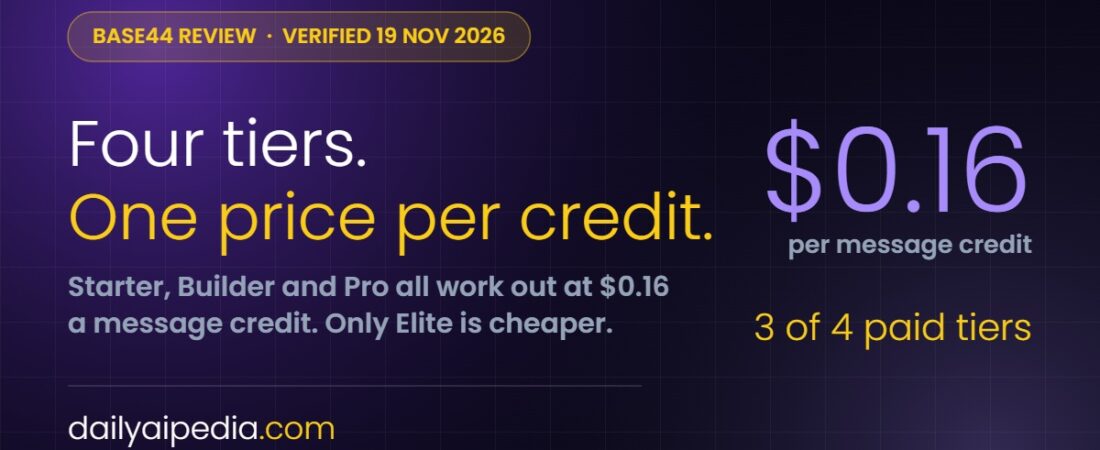
Three of the four paid tiers charge an identical rate. Upgrading from Starter to Pro does not make your building cheaper per unit of work — it buys you more room before you stop, plus the features attached to that tier. Only Elite breaks the pattern, at roughly 17% off the standard rate.
That is worth knowing because the natural assumption with tiered software is that volume earns a discount. Here it does not, so the question is not “which tier is best value” but “how many credits do I actually need, and which features do I need alongside them”.
Integration credits behave differently. Per dollar spent on the yearly rate, Starter gives 125 integration credits a month, while Builder and Pro both give 250 and Elite gives 312. Starter is the outlier: the same message-credit rate, but half the integration allowance of the tier above.
What a credit actually buys
Base44’s documentation publishes rough ranges, and is unusually candid about them:
- A simple visual or text change — about 0.5 credits
- Improving a small feature — about 1 credit
- Adding a complex module — about 2 credits
- A large-scale or app-wide change — about 3 to 4 credits
On Starter’s 100 monthly credits that is roughly 100 small feature improvements, or around 25 to 30 app-wide rebuilds, in a month. For one person building one project, that is a reasonable amount of road. For an agency iterating daily across several clients, it is not.
Two details matter more than the table. First, manual edits in the visual editor cost nothing, so layout and copy fiddling does not eat the budget — only prompts do. Second, unused credits expire at the monthly reset. There is no bank.
The Free plan has a further restriction the pricing page does not mention: its 25 monthly credits are capped at 5 per day, and only on the personal workspace created at signup. Any other workspace you make on the Free plan gets no message credits at all.
What stands out
The backend is genuinely included. Authentication, a database and storage on the free tier, with no “upgrade to add users” wall, is more than most competitors give away, and it is what makes the free tier usable for a real project rather than a demo.
Pricing a prompt by the work rather than by the message is also the fairer model, even if it is harder to predict. A short prompt that triggers a large refactor costs more than a long prompt that changes one word, which is the right way round.
And the documentation is honest in places where marketing pages usually are not — it says outright that credit costs are estimates, that they vary, and that they are calculated after the fact.
What to watch
The unit of pricing is not fixed. Base44’s own docs state there is no set credit amount per message; that published figures are “estimates… subject to change at Base44’s discretion”; that the cost is calculated after an action runs; that there is no way to preview an integration credit cost before running it; and that billing for the same action can differ between workspaces. All of that is reasonable engineering. It also means you are buying a currency whose exchange rate the vendor sets, can change, and does not disclose until after you have spent it. Budget with margin.
“Nothing is locked to the platform” starts at Builder. The FAQ says two-way GitHub sync exports your full source code at any time. GitHub integration is not on Free or Starter — it begins at Builder, $40/mo billed yearly. If portability is the reason you are choosing Base44, the entry tier does not give it to you.
Third-party services bill you separately. Stripe, SendGrid, OpenAI and anything else you connect with your own key charge you directly, on top of your plan. Integration credits cover Base44’s built-in services only.
Downgrades wait. Upgrades apply immediately and are prorated; downgrades take effect at the end of the billing period.
Verdict
Base44 is a strong pick for the person it is aimed at: someone non-technical who wants a real, deployed application and is content to work through a chat window. The free tier is unusually complete, and the fact that the backend is never the upsell is the best thing about the product.
On price, be clear-eyed. There is no volume discount below Elite, so pick the tier that matches your monthly workload rather than reaching for the one that looks like better value — it is the same rate. Start on the free plan to find out what your own work costs in credits, because the published estimates are explicitly not a quote. If source-code portability is part of your decision, your real entry price is Builder at $480 a year, not Starter at $192.
FAQ
Is Base44 free?
Yes, with limits. The Free plan includes the core features, authentication, database and analytics, up to 5 apps and 25 message credits a month — but no more than 5 credits a day, and only on the personal workspace created when you sign up.
How much does Base44 cost?
Starter is $20/mo, or $16/mo billed annually. Builder is $50 or $40, Pro is $100 or $80, and Elite is $200 or $160. Annual billing saves 20% and adds a free domain for a year.
What is a message credit worth?
Base44 estimates about 0.5 credits for a simple text or visual change, 1 for a small feature, 2 for a complex module and 3 to 4 for an app-wide change. The exact amount is calculated after the message runs and is not fixed.
Do unused Base44 credits roll over?
No. Credits reset monthly on your subscription date and anything unused expires. The one exception is a monthly-to-monthly upgrade, where unused credits carry over for one extra cycle.
Can I export my code from Base44?
Yes, through two-way GitHub sync — but only from the Builder tier upward. Free and Starter do not include GitHub integration.
Which Base44 plan is the best value?
Per credit, Starter, Builder and Pro are identical at $0.16 on annual billing. Elite is the only tier with a better rate, at $0.13. Choose by the credits and features you need, not by expecting a volume discount.
Where to check it yourself
Plans and prices are on Base44’s pricing page — open it here and switch the Yearly/Monthly toggle to see both. The credit definitions, the daily Free cap and the estimate caveats are in their documentation at docs.base44.com/Account-and-billing/Credits and docs.base44.com/Account-and-billing/Billing-and-plans. Everything above was read on 19 November 2026; if it changes after that, the vendor’s pages are the authority and this post is not.
Disclosure: DailyAIPedia earns a commission if you sign up to Base44 through our link. It does not change your price, and it did not change the figures above — the per-credit maths is in this review precisely because the pricing page does not present it that way.