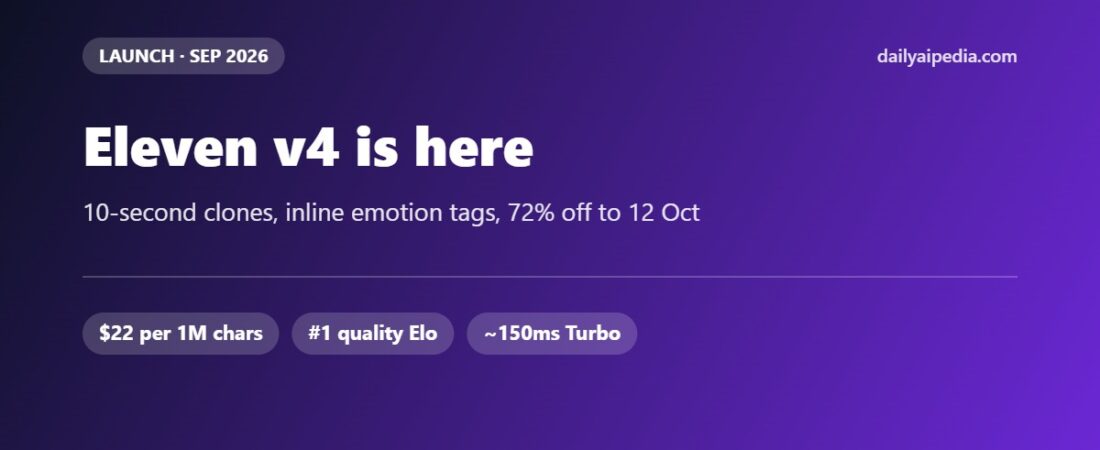
Eleven v4 and v4 Turbo: 10-Second Voice Clones, Inline Emotion Tags, and 72% Off Until 12 October
Disclosure: links to ElevenLabs on this page are referral links. If you sign up through them we may earn a commission, at no extra cost to you. Every.
Disclosure: links to ElevenLabs on this page are referral links. If you sign up through them we may earn a commission, at no extra cost to you. Every price and specification below was read off ElevenLabs’ own pricing page and documentation on 28 September 2026, and the benchmark figure comes from an independent third party.
Update — 4 October 2026: eight days left, and three things we can now confirm
We re-read ElevenLabs’ pricing pages today. The 72% API discount is still live and still ends 12 October, so the rates below are current. Three changes since this post went up:
- The bonus v4 credits offer is now stated publicly, so we have upgraded it from “announced” to verified — with two caveats, below.
- ElevenLabs is running first-month discounts on Starter and Creator that are not part of the API promotion and run to a different date. New section added.
- ElevenLabs’ own voice cloning documentation still says one minute, not ten seconds. Noted in the cloning section.
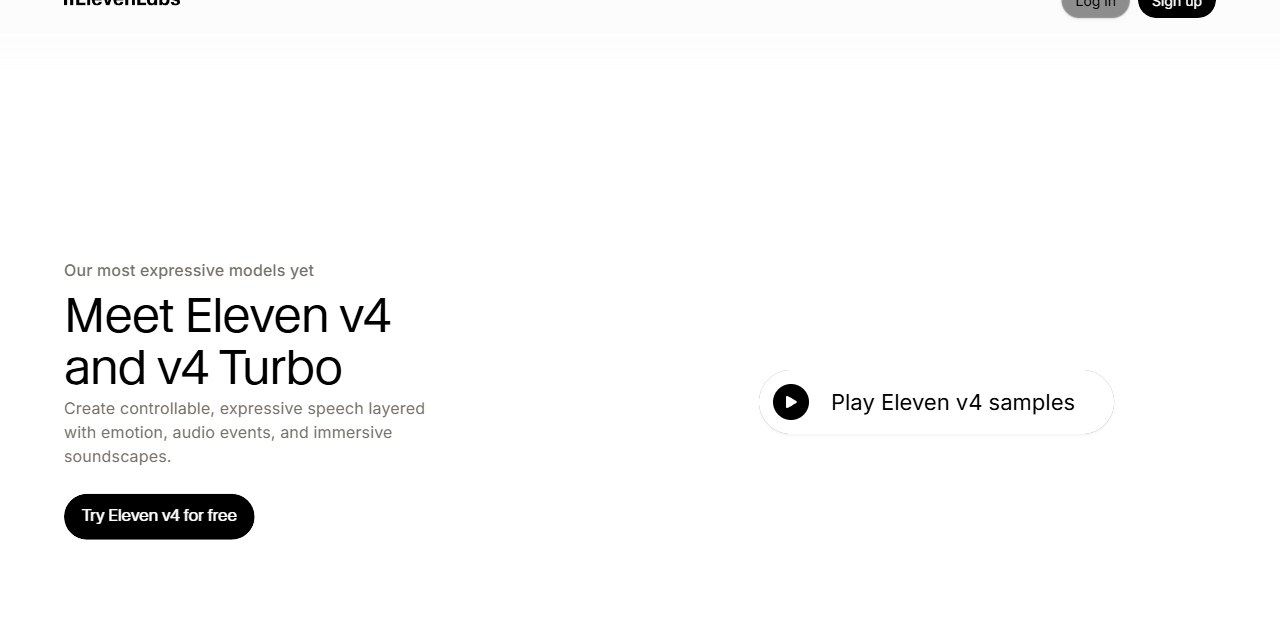
ElevenLabs has released Eleven v4 and Eleven v4 Turbo, built on a new text-to-speech architecture. Three things make this worth your attention rather than another model announcement: instant voice clones now need ten seconds of audio instead of a couple of minutes, delivery can be directed with inline tags written into the script, and the API is 72% off until 12 October.
The short version
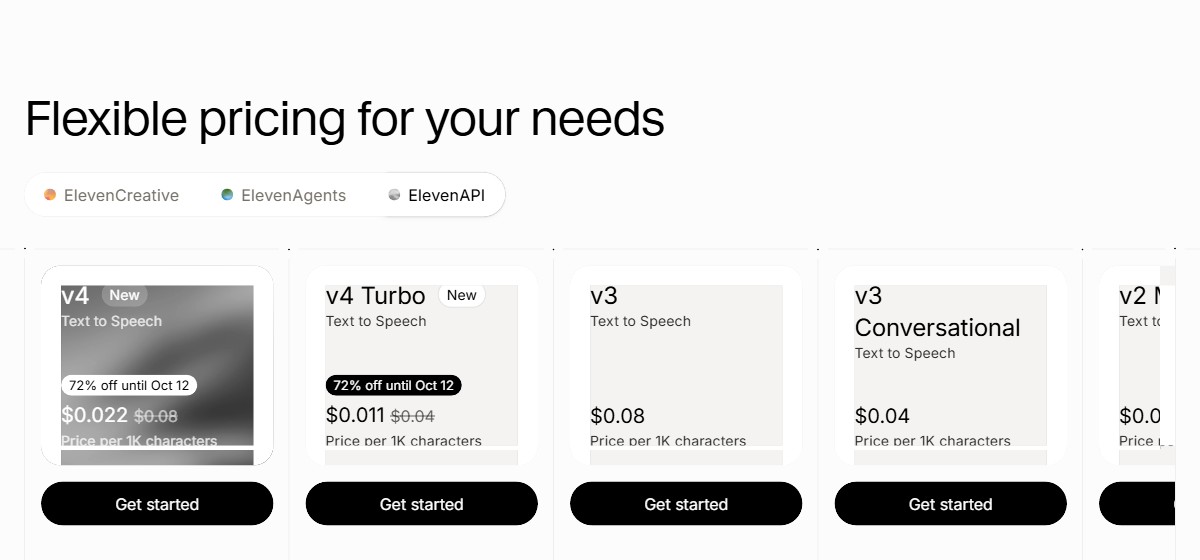
Price, today: $0.022 per 1,000 characters for v4 and $0.011 for v4 Turbo — down from $0.08 and $0.04. That is $22 and $11 per million characters, until 12 October.
Quality, independently measured: Artificial Analysis currently ranks Eleven v4 first in its text-to-speech comparison, with a Quality Elo of 1319.
Cloning: an instant voice clone from ten seconds of audio. Professional clones remain the high-fidelity option.
Control: audio tags like [whispering] or [Pause, dry amusement] written inline, plus 90+ languages (the documentation lists 99).
What the discount is actually worth
| Model | Now (per 1M characters) | From 13 October | Cost per hour of audio now | Cost per hour after |
|---|---|---|---|---|
| Eleven v4 | $22 | $80 | ≈$1.19 | ≈$4.32 |
| Eleven v4 Turbo | $11 | $40 | ≈$0.59 | ≈$2.16 |
| Eleven v3 | $80 | $80 | ≈$4.32 | ≈$4.32 |
| Eleven v3 Conversational | $40 | $40 | ≈$2.16 | ≈$2.16 |
Per-hour figures are our arithmetic, assuming roughly 900 characters of script per minute of speech — about 54,000 characters an hour. ElevenLabs prices by character, not by minute.
Put that next to the rest of the market and the promotional window looks sharper still. Google’s Gemini 3.8 Flash TTS works out around $0.81 an hour on its own promotional rate, and Murf’s Falcon API around $0.54. At $0.59 an hour, v4 Turbo is priced level with the cheapest credible TTS available — while ranking first on quality. After 12 October it returns to $2.16 an hour and that comparison reverses.
The bonus credits offer, now confirmed. When this post went up we could only find the free-v4-credits offer in partner communications. It is now on the public pricing page, in two places that do not quite agree. The site banner reads: “Meet Eleven v4, our most emotive model yet. With 3x credits included on Creator+ until October 12.” Further down the same page: “Try v4 with 2x credits for two weeks. On Creator plans and above, up to 2x your monthly TTS credits used on v4 won’t count against your balance. Available in the web and mobile apps only.”
Our reading, which ElevenLabs has not confirmed: the “2x” is the bonus on top of your normal allowance, and the banner’s “3x” is the total you can spend. Two caveats matter more than the multiplier. It is Creator and above only — Starter does not get it. And it is “web and mobile apps only,” so it does not apply to API usage at all. If you are reading this for the API discount, the credits offer is not additional to it.
Both quotations read off elevenlabs.io/pricing on 4 October 2026.
Inline tags: directing the read without re-recording
The headline capability is control over how a line is delivered. You write the direction into the script itself, and the model performs it:
| Tag type | Examples | What it does |
|---|---|---|
| Emotion | [casual], [annoyed], [ecstatic] | Sets the emotional colour of the line |
| Delivery | [whispering], [shouting], [laughing] | Changes volume, effort and vocal manner |
| Nuance | [quietly curious], [measured], [lower, thoughtful] | Finer direction, closer to how you would brief a voice actor |
| Scene direction | [Quiet, measured narration], [Pause, dry amusement] | Stages a passage rather than a single word |
For anyone producing audiobooks, characters or ads, this replaces the tedious loop of regenerate, listen, adjust settings, regenerate. Two practical constraints from the documentation: SSML is not supported, and on v4 only the Stability and Similarity sliders are available — Style and Speed are not. The tags are the control surface now.
One behaviour change worth knowing if you work across languages: v4 aims for fluent, natural speech in the target language rather than carrying your reference accent across. That is better for localisation and worse if the accent was the point.
Ten-second voice clones change the workflow
Until this release, an instant voice clone wanted one to two minutes of clean audio, and our voice cloning guide was written around that. Ten seconds is a different proposition: you can clone from a voice note, a single take, or a short clip you already have.
The old advice still holds where it matters. Ten seconds of clean, consistent audio beats two minutes of room echo, and the model still copies your pacing and energy exactly as recorded. What has changed is the excuse — there is no longer a reason to skip cloning because you could not face recording a script.
ElevenLabs says professional clones remain the highest-fidelity option, and speaker identity now holds up better across long-form narration, dialogue and regenerated lines. That last point is the quiet win for audiobook work, where a voice drifting between chapters has always been the failure mode.
Worth knowing: ElevenLabs’ own documentation has not caught up. The ten-second figure comes from the Eleven v4 launch post: “Instant Voice Clones can now capture voices with high fidelity using just 10 seconds of audio.” As of 4 October, the Instant Voice Cloning documentation still instructs “Record at least 1 minute of audio” and recommends “approximately 1-2 minutes” — and that page still names Flash v2.5 and Multilingual v2, with no mention of v4. We cannot tell from the outside whether ten seconds is a v4-specific improvement the docs have not been updated for, or marketing running ahead of the product. Treat ten seconds as the floor ElevenLabs claims, and a minute as what its own instructions still ask for.
If you are not using the API: what the plans cost right now
The 72% discount is on API character rates. Most readers of this post will not touch the API — they want to clone a voice and generate audio in the app, and for that the question is which subscription tier. Two things are worth knowing before 18 October.
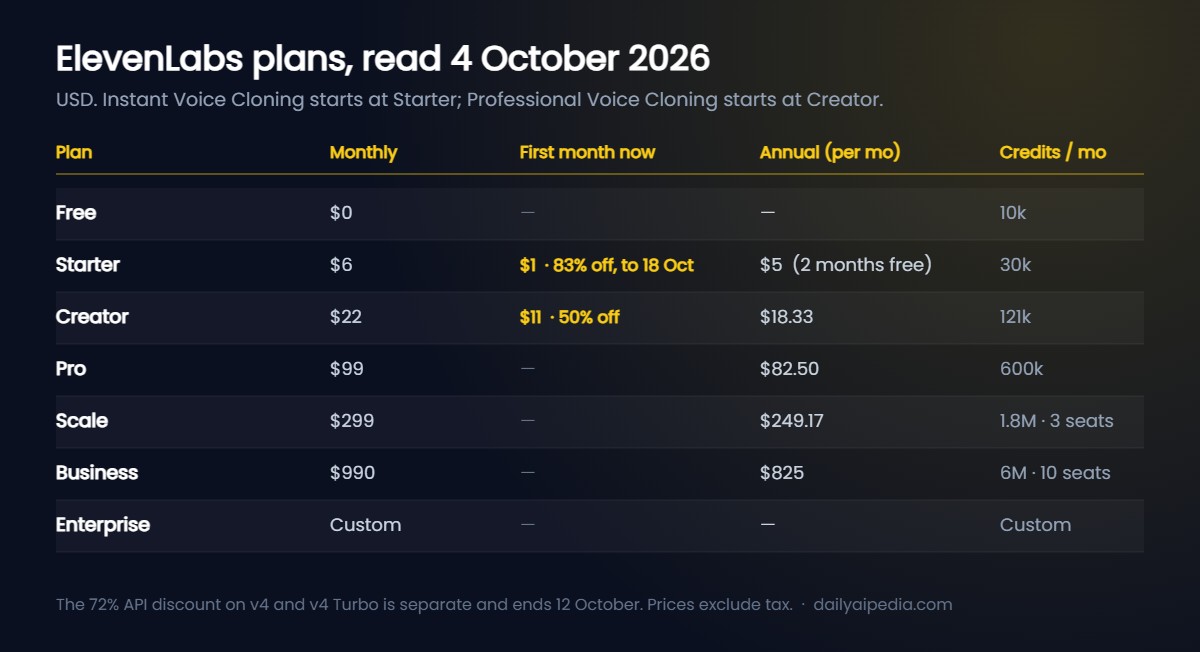
| Plan | Monthly | First month, right now | Annual (per month) | Credits / month |
|---|---|---|---|---|
| Free | $0 | — | — | 10k |
| Starter | $6 | $1 — 83% off, stated “Until Oct 18” | $5 (2 months free) | 30k |
| Creator | $22 | $11 — 50% off, no end date shown | $18.33 | 121k |
| Pro | $99 | — | $82.50 | 600k |
| Scale | $299 | — | $249.17 | 1.8M · 3 seats |
| Business | $990 | — | $825 | 6M · 10 seats |
| Enterprise | Custom | — | — | Custom |
All figures in USD, read off elevenlabs.io/pricing on 4 October 2026, excluding tax. The annual column is ElevenLabs’ “2 months free” rate — ten months’ money for twelve months’ service, so about 17% off, not a separate discount. The Starter promotion is the only one with an end date printed on the page; we would not assume Creator’s runs to the same day.
Which tier you actually need for the thing this post is about. Instant Voice Cloning — the ten-second feature — is not on the free plan. It starts at Starter, which also carries the commercial licence. Professional Voice Cloning starts at Creator. So the cheapest honest answer to “what does it cost to clone my voice in ElevenLabs today” is $1 for the first month and $6 after, and that first-month price is stated to end on 18 October.
A warning about reading that page yourself: ElevenLabs displays the promotional price in the large “per month” slot and the standing price in smaller text beside it. Starter shows “$6 First month 83% off” above a large “$1 per month.” The recurring price is $6, not $1.
v4 Turbo and latency
Turbo is the same expressiveness tuned for real-time use — voice agents, live translation, anything conversational. ElevenLabs publishes two latency figures in two places: the launch page quotes a median ~150ms time to first speech, against Cartesia Sonic 3.6 at 262ms and OpenAI’s GPT-4o mini TTS at 814ms; the pricing page describes it as ~100ms. Both are vendor measurements, and neither includes your own network.
The model IDs, if you are wiring this up: eleven_v4 and eleven_v4_turbo. Both are live in ElevenCreative, ElevenAgents and the API.
Should you switch?
| If you… | Do this | Why |
|---|---|---|
| Produce audiobooks or narration | Test v4 before 12 October | Tag-level direction plus better speaker consistency across long projects |
| Run voice agents | Move to v4 Turbo | Same expressiveness, latency tuned for conversation, and half the price of v4 |
| Localise or dub | Re-test your pipeline | v4 targets native fluency rather than carrying the source accent — that may improve or break your current output |
| Only generate occasionally | Nothing urgent | Credits on paid plans cover casual use; the discount matters most at volume |
| Budget for 2027 | Model at $80 and $40 | The promotional rate ends 13 October. Plan on list price |
The verdict
Two genuinely new things here, and one deadline. The new things are tag-level direction — which removes most of the fiddling from expressive TTS — and ten-second cloning, which removes the setup cost. The deadline is 12 October, after which v4 costs nearly four times as much per hour of audio. If you were ever going to evaluate ElevenLabs properly, this fortnight is when the arithmetic is most in your favour, and an independent first-place quality ranking is a decent reason to look.
You can try both models on the free plan through our ElevenLabs link. For how the subscription plans compare, see our ElevenLabs review and the AI Voice Pricing Tracker, and our voice cloning walkthrough for the step-by-step.
API rates, promotional end date, model IDs, tag syntax and language counts verified against ElevenLabs’ pricing page and documentation on 28 September 2026, and re-verified on 4 October 2026, when the subscription prices, the first-month promotions and the bonus-credits wording were added. The quality ranking is from Artificial Analysis, an independent benchmark, which lists Eleven v4 first with a Quality Elo of 1319. Latency figures are ElevenLabs’ own. Per-hour costs are DailyAIPedia calculations.
Related guides
- How to Clone Your Voice in ElevenLabs: Instant vs Professional, Step by Step
- ElevenLabs Review: Is It the Best AI Voice and Text-to-Speech Generator?
- AI Voice Tool Pricing Tracker: 16 Tools, Verified Every Month
- Gemini 3.8 TTS Is the Cheapest Studio-Grade Voice Right Now — and It Doubles on 1 January
- BytePlus September 2026: Seedream 5.0 Flash, Seedance 2.5 Premium and two new reasoning models