Twin AI Review 2026: 500 Free Credits, a 14-Day Trial, and Two Pricing Pages That Disagree
Twin is an AI agent builder: you describe a recurring job in chat, it builds an agent that does it, and the agent runs on a schedule or.

Twin is an AI agent builder: you describe a recurring job in chat, it builds an agent that does it, and the agent runs on a schedule or a webhook without you. Email triage, lead research, scraping, invoice processing, content production. The pitch is ordinary enough. The pricing is where it gets strange.
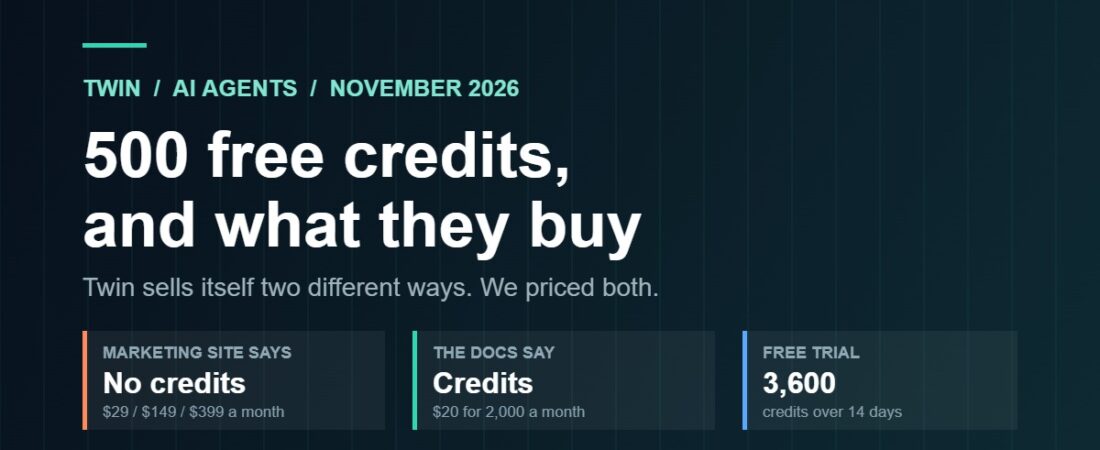
Twin currently describes its own pricing two completely different ways on two live pages, and which one you land on changes the entry price by $9 a month and decides whether you can sign up at all without a sales call. We checked both on 9 November 2026.
There is also a referral offer running: sign up and schedule your first agent and both you and the referrer get 500 credits. That is worth having, and below we work out exactly what 500 credits buys using Twin’s own published figures.
What Twin actually does
Twin sits in the same space as n8n, Make and Zapier, but it builds the automation for you from a chat description rather than asking you to wire nodes together. The templates on its signup screen give the flavour: Email Categorizer, Lead Research Agent, Invoice Processor, Regulatory Monitor, Sales Outreach Agent, Content Engine, Curriculum Builder.
Two modes matter for cost. Build mode uses high-reasoning AI to plan the agent and generate its logic, and it is the expensive one. Run mode executes an already-built agent using a lighter model plus the agent’s memory, and Twin’s docs say repeat runs are "typically 3-10x cheaper" than the original build. Before a build starts, you confirm whether to use high or low reasoning, so the costly step is at least opt-in.
The 500-credit referral offer
The condition is worth reading carefully. It is not sign-up alone — you have to schedule your first agent. Both sides then get 500 credits. On a platform where building is the expensive mode, that means you spend credits to earn credits, though the trial covers the build comfortably.
Here is what 500 credits buys, using the rule-of-thumb costs Twin publishes in its own documentation:
| Task | Twin’s stated cost | 500 credits gets you |
|---|---|---|
| Simple automation (API, filter, email) | 15-30 credits | 16 to 33 runs |
| Scraping job, around 100 items | 20-70 credits | 7 to 25 jobs |
| Browser-agent session, around 20 steps | 100-200 credits | 2 to 5 sessions |
| Image, video or slide generation | 20-50 per asset | 10 to 25 assets |
So the honest framing: 500 credits is a genuinely useful top-up if your agents are lightweight API-and-email jobs, and it is almost nothing if you lean on the browser agent. At Twin’s entry rate of $20 for 2,000 credits, 500 credits is about $5 of value.
The free trial is better than the referral
This is the part the referral copy does not mention. Twin’s documentation describes a self-serve 14-day free trial with 1,000 credits on day one and 200 more each day, up to 3,600 credits across the trial. That is seven times the referral bonus, and it comes with no referral needed.
The two stack, which is the actual reason to use a referral link: trial credits plus the 500 gets you to roughly 4,100 credits before you have paid anything. If you hit zero mid-trial, Twin says it will not interrupt work already in progress.
Now the contradiction
Twin’s marketing pricing page and Twin’s product documentation describe different products.
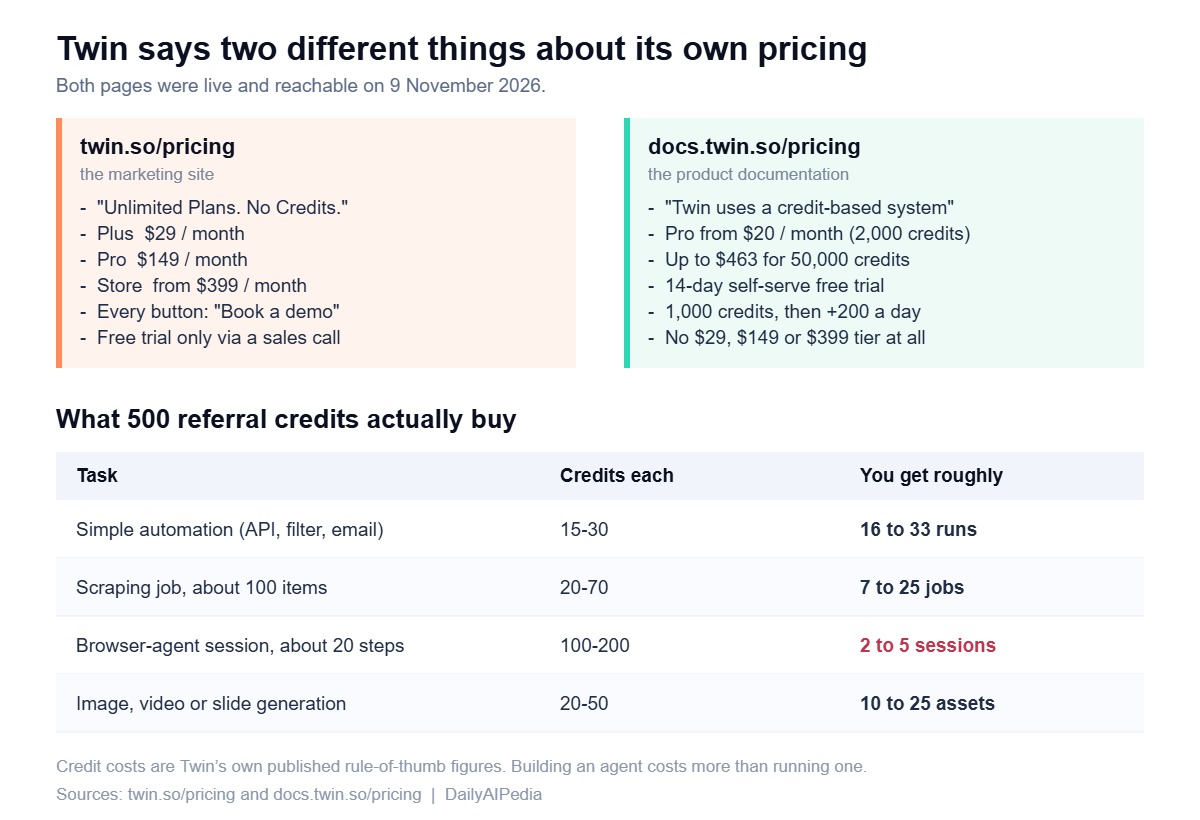
twin.so/pricing is headed "Unlimited Plans. No Credits." It lists Plus at $29 a month, Pro at $149 and Store from $399. Every single call to action on it is "Book a demo" — there is no self-serve checkout anywhere on the page. Its FAQ answers "Is there a free trial?" with "Book a demo and we’ll set one up with you."
docs.twin.so/pricing opens with "Twin uses a credit-based system." It lists Pro as tiered monthly credits starting at $20 for 2,000 credits, rising through $50 for 5,000, $95 for 10,000, $189 for 20,000 and on to $463 for 50,000, with volume discounts reaching 11.8% on the largest packages. It describes the self-serve 14-day trial. It never mentions a $29, $149 or $399 tier.
These cannot both be current. And the app itself sides with the docs: build.twin.so redirects to a builder with open Google, Microsoft and email signup — no demo booking required — and the docs link straight to an in-app credits dashboard at builder.twin.so/credits.
Our read is that the marketing site is ahead of the product, selling a seat-style unlimited plan that the shipping product has not moved to yet. But Twin does not say that anywhere, and if you arrive via twin.so you would reasonably conclude the entry price is $29 and that you need a sales call to try it. Both of those appear to be wrong.
What the marketing skips
- Building costs more than running. Every time you update an agent you pay the high-reasoning build price again, not the cheap run price. Iterating on a fiddly agent is where budgets go.
- The browser agent is the credit sink. At 100-200 credits a session, a $20 month of 2,000 credits is 10 to 20 browser sessions. If browser automation is why you want Twin, price the $95 or $189 tier, not the $20 one.
- Top-up credits expire. Six months, and only while your subscription stays active.
- The advanced features are tier-gated on the marketing page. Browser agent, lead prospecting, image and video generation, deep research and property data are all listed as Pro-and-above, absent from Plus. The docs list those same capabilities as simply part of Pro. Another place the two pages disagree.
- Custom plans are an email address. Shared wallets, teammate invites and member caps are not self-serve; the docs point you at a personal email address at the company.
Who it suits
Worth the trial: you have two or three genuinely recurring jobs — triaging a shared inbox, pulling a weekly report, monitoring a supplier page — and you do not want to learn a node editor. Build once, schedule, forget. At $20 a month for 2,000 credits that is cheap for what it replaces.
Think harder: your workflow needs the browser agent on real websites every day. The credit maths turns against you quickly and a fixed-price tool may cost less.
Probably not yet: you need team seats, shared budgets or predictable per-seat billing. That is exactly the product the marketing page advertises and the docs cannot yet sell you.
Our honest position on this review
We have not run Twin hands-on yet. Everything above comes from Twin’s own published pages and documentation, read on 9 November 2026, and we have said where they disagree rather than picking the version that reads better. We will add a tested section to this post — real agent, real credit burn, real screenshots — once we have run it through a trial. If the numbers differ from the published ones, that update will say so.
Verdict
Twin looks like a capable agent builder with a pricing page that has got ahead of itself. The product you can actually sign up for today is credit-metered, starts at $20 a month, and gives you a 14-day trial worth up to 3,600 credits without talking to anyone. That is a better offer than the marketing site describes, which is an unusual problem for a company to have.
Take the trial, add the 500 referral credits, and spend them building one agent you will actually run every week. You will know inside a fortnight whether the credit model suits your workload — and that is a question no pricing page, either of them, can answer for you.
FAQ
Does Twin have a free trial?
Yes. The documentation describes a self-serve 14-day trial: 1,000 credits immediately, then 200 a day, up to 3,600 in total. The marketing site instead says to book a demo, which appears to be out of date.
How much does Twin cost?
Per the docs, Pro starts at $20 a month for 2,000 credits and scales to $463 for 50,000. The marketing page quotes $29, $149 and $399 flat monthly plans instead.
What do 500 referral credits get me?
Roughly 16-33 simple automation runs, 7-25 scraping jobs, or only 2-5 browser-agent sessions, using Twin’s own cost guidance. About $5 of value at the entry tier.
Do I have to pay to get the referral credits?
No, but you do have to schedule your first agent, not just create an account.
Is Twin like n8n or Zapier?
Same problem, different approach. Twin generates the automation from a chat description instead of asking you to build it node by node, and bills by credits consumed rather than by task count or seat.
Get the 500 credits
If you want to try it, sign up for Twin and schedule your first agent — that unlocks the 500 credits on top of the 14-day trial. Verify the current numbers yourself on twin.so/pricing and docs.twin.so/pricing before you commit to a tier, because one of those two pages is going to change.
More automation coverage: our n8n 3.0 breaking changes write-up.
Affiliate disclosure: the Twin link above is a referral link and both DailyAIPedia and you receive 500 credits if you sign up and schedule an agent. It does not change the prices quoted, which were read from Twin’s own pages on 9 November 2026, or the conclusions reached. We have not been paid by Twin and they did not see this article before publication.