Fireflies Just Raised Its API Limits 10x — and the Free Plan Is Now Genuinely Usable
Disclosure: this post contains an affiliate link to Fireflies.ai. If you sign up through it, DailyAIPedia may earn a commission at no extra cost to you. Fireflies had.

Disclosure: this post contains an affiliate link to Fireflies.ai. If you sign up through it, DailyAIPedia may earn a commission at no extra cost to you. Fireflies had no involvement in this post. Every figure below was read off Fireflies’ own developer changelog on 12 October 2026.
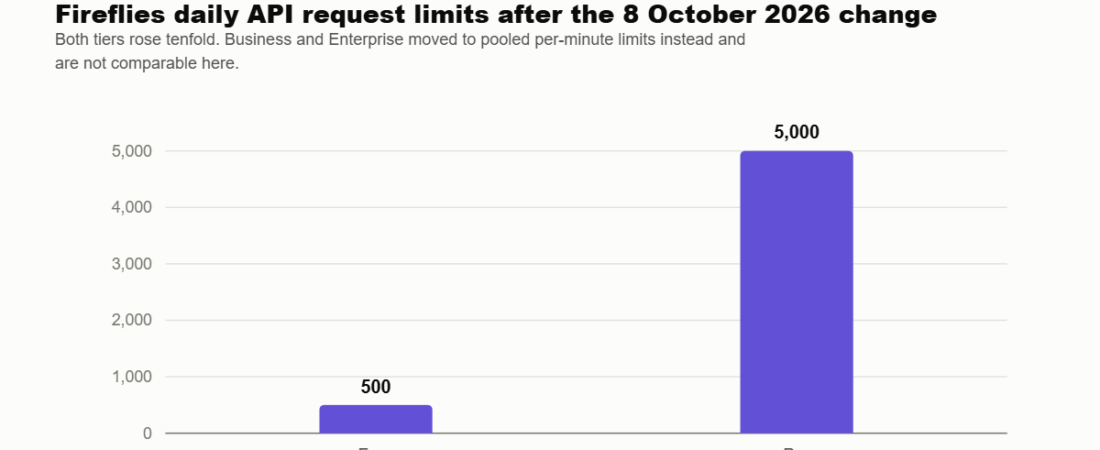
Fireflies raised its API rate limits by a factor of ten on 8 October 2026, and the change lands hardest where it is most useful: the free plan. Fifty requests a day became five hundred.
That sounds like a developer footnote. It is not. Fifty requests a day is a number you hit by accident while testing; five hundred is enough to run a real daily job against your own transcripts without paying anything. If you have ever wanted to pipe your meeting notes somewhere — a database, a CRM, a weekly digest — and gave up because the free API would not carry it, that calculation just changed.
Fireflies daily API request limits after the 8 October 2026 change
Both tiers rose tenfold. Business and Enterprise moved to pooled per-minute limits instead and are not comparable here.
Source: Fireflies’ own developer changelog, read 12 October 2026. Business is pooled at 60 requests a minute per paid seat capped at 1,200 a minute, and Enterprise at 2,400 a minute — different units, so they are excluded rather than converted.
| Plan | Was | Now | What that actually allows |
|---|---|---|---|
| Free | 50 requests/day | 500 requests/day | A genuine daily sync. Roughly one request every three minutes across a working day, or a single batch job pulling hundreds of transcripts. |
| Pro | 500 requests/day | 5,000 requests/day | Enough to drive a live integration rather than a nightly batch. |
| Business | Per-user daily cap | 60 req/min per paid seat, pooled, capped at 1,200 req/min | The cap binds at 20 seats. Past that, extra seats add no API headroom. |
| Enterprise | Per-user daily cap | 60 req/min per paid seat, pooled, capped at 2,400 req/min | The cap binds at 40 seats. |
The quiet change is the shift from daily to per-minute
Free and Pro are still measured in requests per day. Business and Enterprise are not — they moved to 60 requests per minute per paid seat, pooled across the team, with a hard ceiling.
Those are different kinds of limit and they fail differently. A daily budget lets you burn everything in one aggressive batch at 2am and sit idle the rest of the day. A per-minute limit does the opposite: it will never stop a steady trickle, but it will throttle exactly the kind of bulk backfill you run when you first connect something.
So if you are on Business and planning a one-off import of two years of transcripts, the new model is less friendly to you than the old one, not more. Rate-limit your own backfill rather than discovering the ceiling.
The pooling is worth a second look too. Sixty requests a minute per seat, capped at 1,200 on Business, means the cap binds at twenty paid seats. A thirty-seat Business team has the same API throughput as a twenty-seat one. On Enterprise, 2,400 divided by 60 puts the same wall at forty seats.
Dated uploads, and a genuinely odd attendee rule
The same day, Fireflies shipped a second change to createUploadUrl in v2.29.0. It now takes an optional meeting_date, accepting either YYYY-MM-DD or a full timestamp, which must be after 1 January 1970 and not in the future.
This is the fix for a real annoyance. Until now, a recording you uploaded by hand was dated when you uploaded it, not when the meeting happened, so importing an archive produced a pile of transcripts all stamped with today. If you are migrating off another notetaker, this is the field that makes your history look like history.
Attendees passed to createUploadUrl are now saved on the meeting as well. And here is the part to write down, because it will bite someone: an attendee is dropped if its email contains the uploader’s email as a case-sensitive substring.
Read that carefully. It is a deduplication rule meant to stop you appearing twice on your own meeting, implemented as a substring match rather than an equality check. If your address is sam@acme.com, then sam@acme.com.au contains it as a substring and gets dropped. And because the match is case-sensitive, Sam@acme.com does not match at all and survives. Both behaviours are wrong in opposite directions. If you are bulk-importing, check your attendee lists came through intact rather than assuming they did.
What we could not verify
Open questions, stated plainly
- Whether the storage limits moved too. This release raises API request limits. It says nothing about the 400 minutes of storage per team on Free or 8,000 minutes per seat on Pro, which remain the caps that actually decide what Fireflies is worth to you.
- What happens at the ceiling. Fireflies does not say whether exceeding a pooled per-minute limit returns an error, queues the request, or throttles silently.
- Whether Free and Pro also have a per-minute limit. Only the daily figures are published for those tiers. A burst of 500 requests in one second may or may not be allowed.
- Whether the attendee substring rule is intended. We are describing documented behaviour, not a confirmed bug. Fireflies documents it as a rule rather than flagging it as a limitation.
All figures above were read off Fireflies’ own developer changelog at docs.fireflies.ai/getting-started/whats-new on 12 October 2026, with release dates taken from its RSS feed at the same path — note that the HTML page shows version numbers and titles but no dates, so the feed is the only place the 8 October date appears. Plan prices quoted elsewhere on this site were last verified on 1 October 2026 in our pricing check. If anything changes materially, this post gets a dated update box rather than a silent edit.
Frequently asked questions
What is the Fireflies API rate limit on the free plan?
500 requests per day since 8 October 2026, up from 50. That is a tenfold increase and it is the largest proportional change in the release.
What is the Fireflies API rate limit on Pro?
5,000 requests per day, up from 500 on the same date.
How do Business and Enterprise API limits work now?
They are no longer daily. Both are 60 requests per minute per paid seat, pooled across the whole team, with a ceiling of 1,200 requests per minute on Business and 2,400 on Enterprise. Because of those ceilings, Business stops gaining throughput past twenty paid seats and Enterprise past forty.
Can I set the real meeting date when uploading a recording to Fireflies?
Yes, since v2.29.0 on 8 October 2026. The createUploadUrl endpoint takes an optional meeting_date, as either YYYY-MM-DD or a full timestamp, which must be after 1 January 1970 and cannot be in the future. Before this, uploaded recordings were dated when you uploaded them.
Why are some attendees missing after a Fireflies upload?
Fireflies drops an attendee if its email address contains the uploader’s email as a case-sensitive substring. That means an address like sam@acme.com.au is dropped when the uploader is sam@acme.com, while Sam@acme.com is kept because the match is case-sensitive. Check attendee lists after a bulk import rather than assuming they came through.
Did Fireflies change its storage limits in October 2026?
Not in this release. The 8 October changes cover API rate limits and the upload endpoint only. Storage minutes, which are the limit most users actually hit, were unchanged.
Related guides