Claude Opus 5.5 Is Not 40% Cheaper — What the List Price Actually Says
We have no referral relationship with Anthropic, so nothing on this page is sponsored. Every price below was read off Anthropic’s own pricing documentation on 27 September 2026..

We have no referral relationship with Anthropic, so nothing on this page is sponsored. Every price below was read off Anthropic’s own pricing documentation on 27 September 2026.
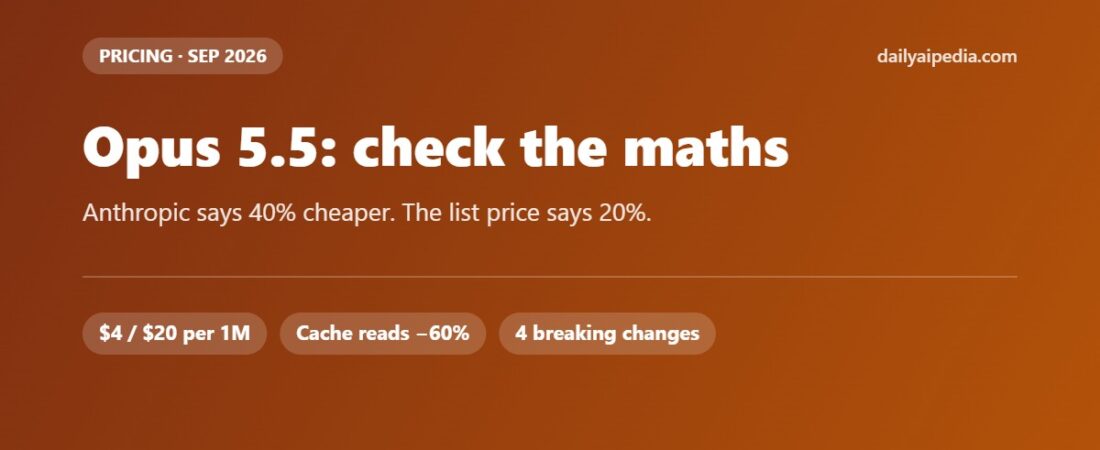
Anthropic released Claude Opus 5.5 on 22 September with a headline that travelled further than the detail behind it: roughly 40% cheaper. Several write-ups turned that into “40% lower token prices”, which is not what the pricing page says. Others reported a 20% cut and stopped there, which undersells it. Both are wrong in the way that matters — what you actually pay depends on how you use the model. Here are the published numbers and the arithmetic.
The short version
List prices fell 20%: $5 / $25 per million input/output tokens on Opus 5 became $4 / $20 on Opus 5.5.
Cache reads fell 60%: $0.50 to $0.20 per million — the biggest single change, and the one that decides whether you see 20% or 40%.
Output is generated 30%+ faster, and Anthropic says answers use fewer tokens, which is the rest of the claim.
Reaching 40% requires both: heavy prompt caching and materially shorter outputs. Run a naive workload and you will see 20%.
What Claude costs per million tokens
| Model | Input | Output | Cache write (5 min) | Cache read |
|---|---|---|---|---|
| Claude Opus 5.5 | $4 | $20 | $5 | $0.20 |
| Claude Opus 5 | $5 | $25 | $6.25 | $0.50 |
| Claude Sonnet 5 | $2 | $10 | $2.50 | $0.20 |
| Claude Haiku 4.5 | $1 | $5 | $1.25 | $0.10 |
The Batch API takes 50% off input and output on every model, so Opus 5.5 batched is $2 / $10. The discount does not apply to cache operations.
Where the “40%” comes from
Take a realistic job: one million input tokens and 100,000 output tokens. Here is the same job priced four ways.
| Scenario | Opus 5 | Opus 5.5 | Difference |
|---|---|---|---|
| No caching | $7.50 | $6.00 | 20% cheaper |
| 80% of input served from cache | $3.90 | $2.96 | 24% cheaper |
| 80% cached, 15% shorter output | $3.90 | $2.66 | 32% cheaper |
| 80% cached, 25% shorter output | $3.90 | $2.46 | 37% cheaper |
Our arithmetic from Anthropic’s published rates. Cached input is billed at the cache-read rate; cache writes are excluded for clarity, and they cost more on Opus 5 than on 5.5 too.
So the 40% figure is reachable, but only where all three levers pull at once: the lower list price, the much cheaper cache reads, and a model that answers in fewer tokens. If your workload is one-shot prompts with long outputs and no caching, budget for 20% and treat anything more as a bonus. If you run an agent that replays a large system prompt on every turn, the cache-read cut alone is worth more to you than the headline.
This is the same pattern we found when checking Google’s new TTS pricing: the published table is reliable, the summary around it usually is not.
Four changes that can break existing code
Opus 5.5 is not a drop-in replacement. Anthropic lists breaking changes against Opus 5:
- Thinking mode cannot be disabled. If your integration turned it off, that setting no longer applies.
- Forced tool use now errors in cases where it previously worked.
- Thinking bounds are enforced.
- The older computer-use tool version is rejected.
There are also access conditions worth knowing before you plan around the model: cybersecurity tasks are routed to Opus 4.8 unless the account is in Anthropic’s Cyber Verification Program, and biology work requires Life Sciences Verification. If either describes your use case, test before you migrate.
If you do not touch the API
For people on Claude’s consumer and team plans, the practical news is simpler: Opus 5.5 is available in the Claude apps and Claude Code, and Anthropic raised usage limits on Pro, Max, Team and Enterprise. The model also reached GitHub Copilot the same week — on Pro+, Max, Business and Enterprise, not the base Pro tier — and is selectable in Replit’s agent, which we covered in our September builder round-up.
The verdict
Opus 5.5 is a real price cut, and the cache-read change is more significant than the headline it was folded into. But “40% cheaper” is a claim about a typical workload, not about token prices, and anyone budgeting from it should do the arithmetic for their own traffic. The published table is the honest source: $4 and $20 per million, $0.20 for cache reads, half of that again on batch.
For how Claude compares with the other assistants day to day, see our ChatGPT vs Claude vs Gemini comparison.
Prices and breaking changes verified against Anthropic’s pricing documentation and Opus 5.5 release notes on 27 September 2026. Cost scenarios are DailyAIPedia calculations from those published rates.
Related guides
- ChatGPT vs Claude vs Gemini: Which One Should You Use?
- Gemini 3.8 TTS Is the Cheapest Studio-Grade Voice Right Now — and It Doubles on 1 January
- Replit, Softr and Bubble in September 2026: MCP Everywhere and Agents With Database Access
- Replit Agent benchmarks: 72% on DeepSWE at $2.11 a task
- ChatLLM by Abacus.AI review: 100+ models for $10 a month
- ChatGPT pricing October 2026: the new $500 Pro tier and every published limit