Kerbrank Review 2026: UK Local Rank Tracking, ChatGPT Checks, and the Cap Nobody Reads
How this review came about: Kerbrank submitted its tool to DailyAIPedia for editorial consideration. This is not a sponsored placement, we were not paid, and we hold no.
How this review came about: Kerbrank submitted its tool to DailyAIPedia for editorial consideration. This is not a sponsored placement, we were not paid, and we hold no affiliate link for it — the outbound links below are unpaid and marked nofollow. It is also not a hands-on test: we verified features, limits and prices against Kerbrank’s own pricing page, methodology and labelled sample report on 12 October 2026, and we have not run a live scan on a real business. Prices are in pounds sterling, as Kerbrank states.
Kerbrank is a UK-focused local visibility tracker. It plots where a business appears in Google Maps from points across an area rather than from a single address, asks ChatGPT whether it gets recommended for relevant local questions, and turns both into a weekly prioritised task list.
The pitch is sound and the pricing is refreshingly flat — there are no scan credits to buy, and weekly readings are included on every plan. But the number that actually decides what you can measure is not the monthly price. It is a line near the bottom of each plan called “map checks a week, at most”, and it is the first thing we would read.
Kerbrank pricing, with the limits that matter
| Plan | Monthly | Yearly | Per business | Businesses | Searches each | Max grid | Map checks a week | Scan now |
|---|---|---|---|---|---|---|---|---|
| Solo | £29 | £290 | — | 1 | 10 | 11 × 11 | 1,210 | 1 a month |
| Pro | £59 | £590 | £19.67 | 3 | 25 | 13 × 13 | 7,800 2,600 a business | 3 a month |
| Agency | £129 | £1,290 | £12.90 | 10 | 50 | 15 × 15 | 16,000 1,600 a business | 10 a month |
| Agency+ | £259 | £2,590 | £10.36 | 25 | 100 | 15 × 15 | 30,000 1,200 a business | 25 a month |
Yearly billing is two months free on every tier, and the per-business column is Kerbrank’s own figure for a plan filled to its business limit. Branded reports start at Pro. Every plan gets a weekly automatic reading of every business and a ChatGPT check of 8 to 12 questions, and Kerbrank is explicit that scans cost £0 each: “No credits to buy or top up. Weekly scans are included, so nothing stops halfway through the month.”
The depth-per-business curve runs backwards
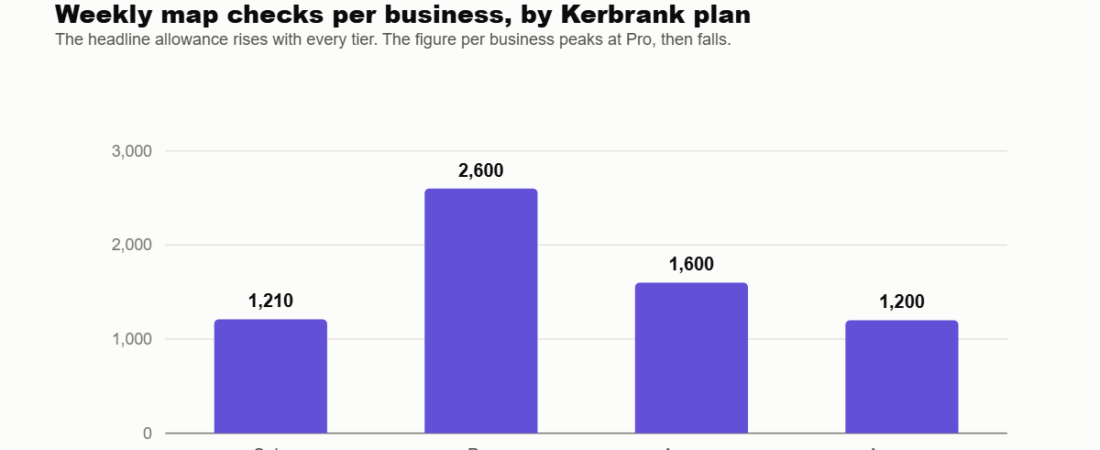
Look again at the map-checks column. The headline total rises with every tier — 1,210, then 7,800, then 16,000, then 30,000 — which is what you would expect. The figure per business does not. It peaks at Pro and then falls:
Weekly map checks per business, by Kerbrank plan
The headline allowance rises with every tier. The figure per business peaks at Pro, then falls.
Source: Kerbrank’s own pricing page, read 12 October 2026. Solo’s figure is its whole allowance, as the plan covers one business; the rest are Kerbrank’s stated per-business shares of 7,800, 16,000 and 30,000.
| Plan | Map checks a week, per business | Points at full grid | Searches you could run weekly at full grid |
|---|---|---|---|
| Solo | 1,210 | 121 (11 × 11) | 10 — exactly the plan’s allowance |
| Pro | 2,600 | 169 (13 × 13) | about 15, against 25 allowed |
| Agency | 1,600 | 225 (15 × 15) | about 7, against 50 allowed |
| Agency+ | 1,200 | 225 (15 × 15) | about 5, against 100 allowed |
The right-hand column is our own arithmetic, dividing each plan’s per-business weekly allowance by the number of points in its largest grid. It is the calculation nobody does before subscribing, and it changes the picture.
Solo is the only tier where the advertised searches and the advertised grid fit inside the weekly cap. 121 points times 10 searches is 1,210, which is the cap to the digit. Above Solo the two numbers stop reconciling: Pro advertises 25 searches and a 13 by 13 grid, but running all 25 at full size every week would need 4,225 checks against an allowance of 2,600. On Agency+ the gap is widest — 100 searches at 225 points is 22,500 checks against 1,200.
We are not calling that a bait and switch, and there are innocent explanations: a grid does not have to be run at maximum size, searches need not all run weekly, and Kerbrank may count a check differently from how we have assumed. But the practical reading stands either way. On the higher tiers you are buying breadth — more businesses, more search terms on file, client branding — not the ability to measure every term across every street every week. If weekly depth on one location is what you want, Pro gives you the most of it, and Solo is the only plan where the sums are clean.
Update, 12 October 2026
Kerbrank’s methodology page confirms the unit our arithmetic above assumed: a reading is one grid point, for one search, reading the top 20 results. So a plan’s weekly allowance is points multiplied by searches, and the table above stands.
It also adds something that softens the finding usefully: grids run from 3 × 3 upwards, not just at each plan’s maximum. Dropping to a smaller grid is how you trade coverage for more tracked search terms inside the same weekly cap — so the higher tiers are workable, provided you do not also run the largest grid. We have written this up in full in how Kerbrank measures local visibility.
What the grid actually shows
Traditional rank checks tell you where a business sits at one point. Kerbrank checks Google Maps positions across a grid of points and reports top-three share, average position and blind spots, keeping each search term separate rather than hiding a weak service behind an overall average.
Its public sample report — for an invented business called Seafront Skin Studio — uses a 9 by 9 grid with 44 spots measured, and explains why the rest were outside the area or left out. That transparency is worth more than it sounds: a missing map result, an unmeasured grid point and a genuinely poor ranking are three different states, and a tool that blurs them is worse than no tool.
The usual caveat applies and Kerbrank says it too: rankings vary by search term and location, so one grid cannot prove what every customer sees.
The ChatGPT check is sampling, not measurement
Kerbrank asks ChatGPT locally framed recommendation questions and counts how often the business comes back, alongside the competitors it names and the sources it cites. The plans specify 8 to 12 questions; the published sample runs 8 questions three times each, which is where its “6 of 24” style figures come from.
Treat those as directional. Twenty-four samples is enough to notice that you are invisible for implants while two rivals are not — which is genuinely useful — and nowhere near enough to call it a market share. Kerbrank frames it correctly as monitoring rather than a guarantee of what any future customer will be told, and we would read the exact prompts and named sources rather than the headline rate.
Weekly rescans, and the honest bit about attribution
Automatic weekly readings come with every paid plan, seven days apart, for every business. The report tracks changes against like-for-like maps and searches, and you can mark a suggested job as done so the next scan checks whether the issue is still there.
Kerbrank then does something most tools in this category avoid: it distinguishes detecting that a fix landed from proving the fix caused a ranking change. In local SEO that distinction is the whole ballgame, and a vendor volunteering it is a point in its favour.
Reports, trial and terms
Reports share by private link or export as PDF. Pro and above carry your own branding; Agency tiers group businesses under clients. The public sample is the best way to judge report depth before paying, bearing in mind its business and figures are invented.
The trial is 14 days with no card to start, running on Solo limits, and Kerbrank says scanning pauses rather than auto-charging if you pick no plan. A separate free 25-point check runs one search from 25 spots with no account at all, which is the fastest way to see whether the output means anything for your business.
Three terms the pricing page states that are worth knowing: card payments go through Stripe, there are 14 days to change your mind, and unused readings are refunded within 30 days of your first payment.
Who should try it
Kerbrank is a sensible shortlist candidate for a UK clinic, salon, trades business or restaurant trying to understand where it is visible beyond its own front door, and for a freelancer or small agency that needs repeatable client reporting. The pound pricing and UK framing are a drawback if your customers are mostly elsewhere.
Start narrow: one business, a few commercially relevant searches, and an area that matches where customers actually come from. Compare the first map with the next weekly reading, and inspect the underlying spots before treating a small percentage movement as meaningful.
What we could not verify
Open questions, stated plainly
- Output accuracy. We have not run a live scan against a real business, so we cannot speak to how closely the grid matches what customers see.
- What happens at the weekly cap. Nothing published says whether hitting it queues the remaining searches, skips them, or shortens the grid. Updated 12 October 2026: the unit itself is now confirmed — see the update box above.
- What happens at the weekly cap. Nothing published says whether hitting it queues the remaining searches, skips them, or shortens the grid.
- ChatGPT model and method. The check is described as locally framed questions, but no model version, region setting or account type is stated — all of which change what ChatGPT answers.
- Search demand estimates. The reports include local demand figures without naming a source, so we cannot say how they are derived.
- Whether the sample reflects a real plan. The public sample uses a 9 by 9 grid, which is smaller than any paid tier’s maximum, so report depth on a real subscription may differ.
Verdict
Kerbrank puts Google Maps grid tracking, sampled ChatGPT visibility and a practical fix list into one UK-oriented workflow, with no scan credits and a no-card trial. Its best quality is epistemic restraint: it separates measurement from proof, labels its sample as invented, and does not promise rankings.
The reason to read the limits closely is not that they are hidden — they are published, which is more than many competitors manage — but that the headline numbers and the weekly caps tell different stories. Buy the tier that matches the depth you need on each location, not the one with the biggest search allowance.
All prices, limits and features above were read off Kerbrank’s own pricing page, methodology and labelled sample report on 12 October 2026. The searches-at-full-grid and points-per-grid figures are our own arithmetic from Kerbrank’s published allowances. Kerbrank submitted this tool to DailyAIPedia for consideration and we hold no referral link for it. If prices change materially, this post gets a dated update box rather than a silent edit.
Frequently asked questions
How much does Kerbrank cost?
Solo is £29 a month or £290 a year, Pro £59 or £590, Agency £129 or £1,290, and Agency+ £259 or £2,590. Yearly billing is two months free on every tier. Prices are in pounds sterling and payments go through Stripe.
Is there a free Kerbrank trial?
Yes, 14 days with no card required, running on Solo limits. Kerbrank says scanning pauses rather than charging automatically if you do not pick a plan. There is also a free 25-point rank check that runs one search from 25 spots with no account at all.
Do Kerbrank scans cost credits?
No. Kerbrank states scans cost £0 with no credits to buy or top up, and a weekly reading of every business is included on every paid plan. What is capped instead is map checks a week: 1,210 on Solo, 7,800 on Pro, 16,000 on Agency and 30,000 on Agency+.
Which Kerbrank plan gives the most depth per business?
Pro, on the published figures. Its weekly allowance works out at 2,600 map checks a business, against 1,600 on Agency and 1,200 on Agency+. The totals rise with each tier but the per-business figure peaks at Pro, so the higher plans buy breadth rather than weekly depth on any one location.
How does Kerbrank check ChatGPT?
It asks locally framed recommendation questions and counts how often the business appears, showing named competitors and cited sources. Plans specify 8 to 12 questions; the public sample runs 8 questions three times each, giving 24 samples. These are sampled AI answers, not a guarantee of what a customer will be told.
How big is the Kerbrank map grid?
Up to 11 by 11 on Solo, 13 by 13 on Pro, and 15 by 15 on Agency and Agency+ — 121, 169 and 225 points respectively. The public sample report uses a 9 by 9 grid with 44 spots measured.