Ads Are Coming to ChatGPT: Which Plans Show Them and What It Costs to Opt Out
We have no referral relationship with any product named on this page, so nothing here is sponsored. Every quote comes from the company’s own published pages, read on.
We have no referral relationship with any product named on this page, so nothing here is sponsored. Every quote comes from the company’s own published pages, read on 18 September 2026.
There is a line on OpenAI’s pricing page, under the $8 Go plan, that most people scroll past: “This plan may include ads.” It is the first time a major AI assistant has put advertising inside a tier that people pay for, and it tells you more about where this industry is heading than any model release this month.
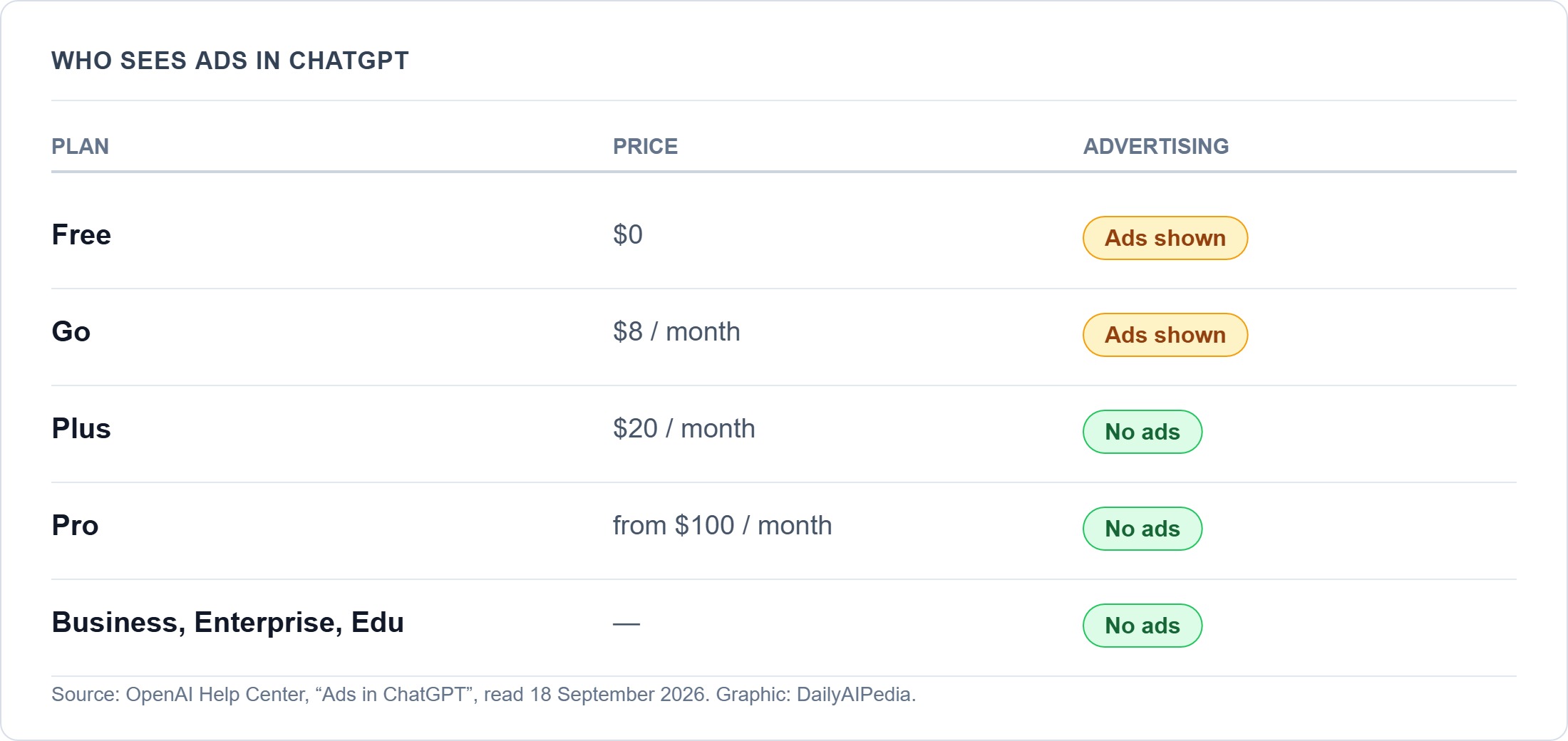
Who sees ads
| Plan | Price | Ads? |
|---|---|---|
| Free | $0 | Yes |
| Go | $8/mo | Yes |
| Plus | $20/mo | No |
| Pro | from $100/mo | No |
| Business, Enterprise, Edu | — | No |
OpenAI’s help centre: “Ads may appear for users on the Free and Go plans. Plus, Pro, Business, Enterprise, and Edu accounts will not have ads.”
What the ads actually are
They appear below the end of a response, and OpenAI says they are “clearly labeled as sponsored and visually separated from ChatGPT’s response.” They are chosen from “the context and intent of your current conversation”, and with personalisation on, from “select signals from your broader ChatGPT experience”.
The claim that matters most is this one: “Ads do not influence the answers ChatGPT gives you.” That is the line the whole arrangement rests on, and it is the line to watch over the next year.
The privacy commitments, in their own words
- “We keep your conversations with ChatGPT private from advertisers, and we never sell your data to advertisers.”
- Advertisers do not receive “your chats, chat history, memories, name, email, precise location, IP address, or sensitive information.”
- No ads for users predicted to be under 18.
- Testing excludes sensitive topics including health, mental health and politics.
- “We’ll always offer a way to not see ads in ChatGPT, including a paid tier that’s ad-free.”
Your controls
Under Settings › Ad Controls you can turn off ad personalisation, clear the data used for ads, see why a particular ad was shown, and dismiss ads with feedback. There is also a three-dot menu on each ad to hide it or report it.
Note what those controls do and do not do. They change which ads you see and what informs them. On Free and Go, they do not remove ads. The only removal is paying $20 for Plus.
OpenAI is not first, and that is the interesting part
Perplexity began experimenting with advertising back in November 2024, with “sponsored follow-up questions and paid media positioned to the side of an answer”, and made a similar promise: “the content of the answers you receive on Perplexity will not be influenced by advertisers.”
So ads in AI answers are not new. What is new is the placement in the pricing ladder. Perplexity put ads in a free product. OpenAI has put them in a paid one, and then priced the ad-free escape at two and a half times the cost. That is a deliberate structure: Go is not a cheap Plus, it is a different product with a different revenue model.
What this means if you are choosing a plan
| If you… | Then |
|---|---|
| Use ChatGPT casually and do not mind ads | Free or Go. Turn off ad personalisation in settings. |
| Were considering Go to save $12 a month | Understand you are paying partly in attention. The gap between Go and Plus is now more than message limits. |
| Use it for client or commercial work | Plus at minimum. An ad appearing under an answer you screen-share is not a good look. |
| Are comparing assistants on price | Compare ad-free to ad-free. See our ChatGPT vs Claude vs Gemini comparison. |
The bottom line
Advertising in AI assistants was always coming; subscriptions alone were never going to fund inference at this scale. OpenAI has been unusually specific about the boundaries — no ad influence on answers, no chat data to advertisers, no ads for minors, a permanently available paid escape — and those commitments are worth holding them to.
The practical takeaway is smaller and more immediate. If you are on Go, or thinking about it, you are on the ad-supported side of the line. The cheapest ad-free ChatGPT is $20 a month, and that is the number to compare against Claude Pro at $17 and Perplexity Pro at $17 when you are deciding where your subscription goes.
Quotes and plan details read from OpenAI’s Ads in ChatGPT help article, its approach to advertising announcement, and the Perplexity advertising post on 18 September 2026. Policies change; check the source before relying on them.
Related guides
- Custom GPTs Are Being Retired: Dates, What Transfers, and What You Rebuild
- ChatGPT vs Claude vs Gemini: Which One Should You Use?
- How to Choose the Right AI Tool Without Wasting Money
- Claude Fable 5.1 vs Mythos 5.1: New Features, Pricing and Access
- ChatGPT pricing October 2026: the new $500 Pro tier and every published limit